A car covers its journey at the speed of 60 km/hr in 10 hours. If the same distance is to be covered in 4 hours, by how much the speed of the car will have to increase?
90 km/hr
150 km/hr
120 km/hr
125 km/hr
Difficulty Level: 1
Positive Marks: 2.00
Negative Marks: 0.66

A man can row with a speed of 12 kmph in still water. If the stream flows at 4 kmph, then the speed downstream is?

12 kmph

16 kmph

8 kmph

20 kmph

Difficulty Level: 1
Positive Marks: 2.00
Negative Marks: 0.66
What number has a 6:1 ratio to the number 12?
72
36
48
2
Difficulty Level: 1
Positive Marks: 2.00
Negative Marks: 0.66
Ramesh professes to sell his goods at the cost price but he made use of 900gms instead of a kg, what is the gain percentage?
10.89%
11.11%
12.04%
11.43%
Difficulty Level: 1
Positive Marks: 2.00
Negative Marks: 0.66

If a number is chosen at random from the set {11,12,13,14,...99},then the probability that the chosen number is a perfect square is:

1/25

6/89

9/13

14/17

Difficulty Level: 1
Positive Marks: 2.00
Negative Marks: 0.66

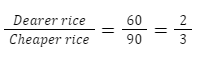
The ratio in which the price at Rs 7.20 a kg be mixed with rice at Rs 5.70 a kg to produce a mixture worth Rs 6.30 a kg is:

2/3

4/3

5/6

4/5

Difficulty Level: 1
Positive Marks: 1.00
Negative Marks: 0.33
The ________ fighter ace of the First World War, Baron Manfred Von Richthofen, was known as the Red Baron.

great
greater
greatest
bigger
Difficulty Level: 1
Positive Marks: 1.00
Negative Marks: 0.33

What is the synonym of the word 'pitcher'?

bounce

kettle

hitting hard

catcher

Difficulty Level: 1
Positive Marks: 1.00
Negative Marks: 0.33

Assertion (A): Plants are green.

Reason (R) : Plants contain chlorophyll which gives it the color green.

Both A and R are true

Both A and R are false

A is true but R is false

R is true but A is false

Difficulty Level: 1
Positive Marks: 1.00
Negative Marks: 0.33

Find the odd one out.

Banquet, Carnival, Ravenous, Merry -making.

Merry -making

Ravenous

Carnival

Banquet

Difficulty Level: 1
Positive Marks: 1.00
Negative Marks: 0.33
If we can construct 14 distinct BSTs from X number of nodes then value of X is ___?
4
Difficulty Level: 1
Positive Marks: 1.00
Negative Marks: 0.00
In a 10-ary tree with 10 internal nodes, what will be the number of leaf nodes __?
91
Difficulty Level: 1
Positive Marks: 1.00
Negative Marks: 0.00
The count of Leaf nodes in an N-ary tree, if I are the total number of internal nodes, is?
(N – 1) * I
(N – 1) * I + 1
(N) * I + 1
(N) * I -1
Difficulty Level: 1
Positive Marks: 2.00
Negative Marks: 0.66
Which of the following statement(s) is/are False?

P: An arbitrary Directed Acyclic Graph(DAG) G=(V,E) is given as an adjacency list. Topological sort: the vertices of G can be completed in linear time?

Q: In the merge-sort execution tree, roughly the same amount of work is done at each level of the tree

Only P
Only Q
Both P and Q
Neither P nor Q
Difficulty Level: 1
Positive Marks: 1.00
Negative Marks: 0.33
What will be the complexity of finding all pairs shortest pair paths by repeatedly running the Bellman Ford algorithm from each vertex?
O(V^4)
O(V^3)
O(V^2)
O(V^5)
Difficulty Level: 1
Positive Marks: 1.00
Negative Marks: 0.33
The runtime of a divide-and-conquer algorithm is described by the following recurrence: T(n) = 5T(n/2) + O(1). How many subproblems will we have at the 7th level of recursion if the top level is considered to be the 0th level__________?
78125
Difficulty Level: 1
Positive Marks: 1.00
Negative Marks: 0.00
Suppose we have a heap containing n = 2^k elements in an array of size ‘n’, and suppose that we repeatedly extract the minimum element, ‘n’ times, never performing insertions. To make the heap space efficient, we move the heap over to an array of size 2^j whenever an extraction decreases the number of elements to 2^j for any integer j. Suppose that the cost of each such move is Θ(2^j). What is the total movement cost caused by ‘n’ extract-mins starting from the heap of n elements? (Ignore the Θ(n log n) cost from the heapify operations themselves.)

Θ(n)
Θ(2^n)
Θ(logn)
Θ(nlogn)
Difficulty Level: 1
Positive Marks: 2.00
Negative Marks: 0.66
Suppose we store n elements in an m-slot hash table using chaining, but we store each chain (set of elements hashing to the same slot) using a heap instead of a linked list. Each element corresponds to a key/value pair and there are no duplicates. Also suppose that m = n, so the load factor α = n/m = 1. What is the worst case time complexity to insert in this new hash table ? (Assume that there will be no resizing of the table.)
O(1)
O(logn)
O(n)
None of these
Difficulty Level: 1
Positive Marks: 2.00
Negative Marks: 0.66
Consider a set containing ‘n’ positive numbers and a value ‘m’. Check whether the subset of the given set with sum equal to given sum exists or not.

Consider the following recursive implementation of the given problem

What will be the X and Y ?

X = SubsetSum(set, n-1, m – 1) , Y = SubsetSum(set, n - 1, m - set[n-1])
X = SubsetSum(set, n-1, m), Y = SubsetSum(set, n-1, m - set[n-1])
X = SubsetSum(set, n-1, m), Y = SubsetSum(set, n, m – set[n-1])
X = SubsetSum(set, n-1, m-1), Y = SubsetSum(set, n, m – set[n-1])
Difficulty Level: 1
Positive Marks: 2.00
Negative Marks: 0.66
Which one is the guideline of Referential integrity in a relationship ?
Do not enter a value in the primary key field of child table if that value does not exist in the primary key of the parent table
Do not enter a value in the foreign key field of a parent table if that value does not exist in the primary key of the child table
Do not enter a value in the foreign key field of a child table if that value does not exist in the primary key of the parent table
Do not enter a value in the foreign key field of child table if that value does not exist in the foreign key of the parent table
Difficulty Level: 1
Positive Marks: 1.00
Negative Marks: 0.33
Consider the join of a relation R with relation S. If R has 20 tuples and S have 10 tuples, then the maximum size of join is:
200
30
15
60
Difficulty Level: 1
Positive Marks: 1.00
Negative Marks: 0.33
Consider the following four relational schemas. For each schema, all non-trivial functional dependencies are listed. The underlined attributes are the respective primary keys.

Schema I: Registration (rollno, courses)

Field ‘courses’ is a set-valued attribute containing the set of courses a student has registered for.

Non-trivial functional dependency: rollno → courses

Schema II: Registration (rollno, courseid, email)

Non-trivial functional dependencies:

rollno, courseid → email

email → rollno

Schema III: Registration (rollno, courseid, marks, grade)

Non-trivial functional dependencies:

rollno, courseid → marks, grade

marks → grade

Schema IV: Regstration (rollno, courseid, credit)

Non-trivial functional dependencies:

rollno, courseid → credit

courseid → credit

Which one of the relational schemas above is in 3NF but not in BCNF?

Schema I
Schema II
Schema III
Schema IV
Difficulty Level: 1
Positive Marks: 2.00
Negative Marks: 0.66
Consider the database table by name Student given below:

Course_Id

Course_Title

Course_Fee

C01

C02

C03

C04

Oracle

Java

C++

Oracle

8000

5000

4000

7000

What is the output of the following SQL query?

SELECT Count (*)

FROM (

(SELECT Course_Id, Course_Title

FROM Student) AS S

NATURAL JOIN

(SELECT Course_Title, Course_Fee

FROM Student) AS T

);

5
6
7
16
Difficulty Level: 1
Positive Marks: 2.00
Negative Marks: 0.66
Which data transformation technique is used to reduce the number of data attributes while retaining the original dataset’s key features?
Discretization
Sampling
Normalization
Dimensionality reduction
Difficulty Level: 1
Positive Marks: 1.00
Negative Marks: 0.33
You are discretizing a continuous variable with values ranging from 0 to 100 into 5 equal-width bins. What is the width of each bin?
20
Difficulty Level: 1
Positive Marks: 2.00
Negative Marks: 0.00
You have a dataset with values [10, 20, 30, 40, 50]. What is the standard deviation if the mean is 30? (Upto 2 decimals)
14.14
Difficulty Level: 1
Positive Marks: 2.00
Negative Marks: 0.00
Which of the following statement is true for a multilayered perceptron?
Output of all the nodes of a layer is input to all the nodes of the next layer
Output of all the nodes of a layer is input to all the nodes of the same layer
Output of all the nodes of a layer is input to all the nodes of the previous layer
Output of all the nodes of a layer is input to all the nodes of the output layer
Difficulty Level: 1
Positive Marks: 1.00
Negative Marks: 0.33
Which of the following is true for a decision tree?
A decision tree is an example of a linear classifier.
The entropy of a node typically decreases as we go down a decision tree
Entropy is a measure of purity
An attribute with lower mutual information should be preferred to other attributes
Difficulty Level: 1
Positive Marks: 1.00
Negative Marks: 0.33
A function g(x) is given to you such that the CDF (cumulative distribution function) of g(x) is sigmoid of x. Given this scenario, what is the value of PDF (probability density function ) value of g(x) at x = 0. Input your answer upto two decimal places.
0.25
Difficulty Level: 1
Positive Marks: 1.00
Negative Marks: 0.00
Which of the following relation is correct for a negative skewed distribution?
Mean=Mode=Median
Mean>Median>Mode
Mode>Median>Mean
Mean>Mode=Median
Difficulty Level: 1
Positive Marks: 2.00
Negative Marks: 0.66
Consider a quiz game where a person is given two questions and must decide which question to answer first. Question 1 will be answered correctly with a probability of 0.8, and the person will then receive a prize of 100 dollars, while question 2 will be answered correctly with a probability of 0.5, and the person will then receive a prize of 200 dollars. If the first question attempted is answered incorrectly, the quiz terminates, i.e., the person is not allowed to attempt the second question. If the first question is answered correctly, the person is allowed to attempt the second question. Which question should be answered first to maximize the expected value of the total prize money received?
question 1
question 2
Both question1 and 2
Neither
Difficulty Level: 1
Positive Marks: 2.00
Negative Marks: 0.66
2, Euclidean Distance
√2, Manhattan Distance
√6, Euclidean Distance
6, Euclidean Distance
Difficulty Level: 1
Positive Marks: 2.00
Negative Marks: 0.66
Consider you have data with 90% of negative points, and 10% of the positive points, and it is given that predicting a positive point as negative points will cost a lot more than predicting negative points as a positive data point. Which of the error metric will be more appropriate for this data set?
F1 Score
Accuracy
Both a&b
None of the above
Difficulty Level: 1
Positive Marks: 2.00
Negative Marks: 0.66

[MSQ]

0, 1, 3, 2, 4, 5, 6
1, 0, 3, 5, 4, 2, 6
6, 5, 4, 3, 0, 1, 2
5, 3, 4, 6, 0, 1, 2
Difficulty Level: 1
Positive Marks: 1.00
Negative Marks: 0.00
A* Search with a heuristic h(n) is guaranteed to find an optimal solution if h(n) satisfies which property?
Admissibility only
Consistency only
Both admissibility and consistency
Completeness only
Difficulty Level: 1
Positive Marks: 1.00
Negative Marks: 0.33
How many minimum parameters are required to represent the following Bayesian Network, if each variable is Boolean?

12
Difficulty Level: 1
Positive Marks: 2.00
Negative Marks: 0.00
Suppose we do Iterative Deepening Search (IDS) but instead of increasing depths as 1,2,3,4... we increase it as 1,2,4,8,16... i.e. double the depth instead of increasing it by 1.This modified version of IDS is [MSQ]

Optimal but not complete
Complete but not optimal
More efficient than standard IDS in the worst case
Less efficient than standard IDS in the worst case
Difficulty Level: 1
Positive Marks: 2.00
Negative Marks: 0.00
Which of the following statements about informed and uninformed search is true?
Uninformed search algorithms can always find the shortest path faster than informed search algorithms.
Informed search algorithms guarantee finding the shortest path if a heuristic function is admissible and consistent.
Both informed and uninformed searches require heuristic information to guarantee completeness.
Breadth-First Search is an example of an informed search algorithm.
Difficulty Level: 1
Positive Marks: 2.00
Negative Marks: 0.66
The school orchestra is planning to play six pieces of music at their next concert. How many different programs are possible?
720
Difficulty Level: 1
Positive Marks: 1.00
Negative Marks: 0.00
Suppose 15 men out of 300 men and 25 women out of 1000 are good orators. An orator is chosen at random. Find the probability that a male person is selected.
15/40
21/20
12/13
None of these
Difficulty Level: 1
Positive Marks: 1.00
Negative Marks: 0.33
If P (A') =0.7, P (B) = 0.7, P(B/A)=0.5, find P(A/B) and P(AUB) (Upto 2 decimals)
0.85
Difficulty Level: 1
Positive Marks: 1.00
Negative Marks: 0.33
A class of 30 students occupy a classroom containing 5 rows of seats, with 8 seats in each row. If the student seat themselves at random, the probability that the sixth seat in the fifth row will be empty is
1/2
1/3
1/4
1/5
Difficulty Level: 1
Positive Marks: 1.00
Negative Marks: 0.33
There are 8 finalists in the 100-meter sprint at the Olympic games. Suppose 4 of the runners are from the United States and that all the runners have an equal chance of winning. What's the probability that runners from the United States finish in 1st, 2nd, and 3rd place?

Choose the correct option: [MSQ]

0.0741
0.0714
7.14%
None of these
Difficulty Level: 1
Positive Marks: 2.00
Negative Marks: 0.00
Three individuals A, B, and C have applied for a job at a private firm. Their chances of selection are in the ratio 1:2:4. The probabilities that A, B, and C can bring about changes to boost the company's profits are 0.8, 0.5, and 0.3, respectively. If the desired change doesn't occur, find the probability that it is due to the appointment of C.
0.6
0.23
0.7
1.23
Difficulty Level: 1
Positive Marks: 2.00
Negative Marks: 0.66
Three coins are tossed at the same time. We say A as the event of receiving at least 2 heads. Likewise, B denotes the event of getting no heads and C is the event of getting heads on the second coin. Which of these is mutually exclusive?

Choose the correct option: [MSQ]

A&B are mutually exclusive
B&C are mutually exclusive
Both are correct
None of these
Difficulty Level: 1
Positive Marks: 2.00
Negative Marks: 0.00
In a survey, 60% of people prefer tea, and 40% prefer coffee. Out of those who prefer tea, 70% are women. Out of those who prefer coffee, 60% are men. Calculate the marginal probability of being a woman (Upto two decimals)
0.58
Difficulty Level: 1
Positive Marks: 2.00
Negative Marks: 0.00
Let A =

If AB = C, then find the matrix A^2.

None of the above
Difficulty Level: 1
Positive Marks: 1.00
Negative Marks: 0.33
27A
3A
A
9A
Difficulty Level: 1
Positive Marks: 1.00
Negative Marks: 0.33
If B is an idempotent matrix, and A = I − B, then

Choose the correct option: [MSQ]

Difficulty Level: 1
Positive Marks: 1.00
Negative Marks: 0.33
The matrix is given by, A = Find |A| .
-20
20
10
-10
Difficulty Level: 1
Positive Marks: 1.00
Negative Marks: 0.33
Let A =

If u1 and u2 are column matrices such that

Difficulty Level: 1
Positive Marks: 2.00
Negative Marks: 0.66
Given that following square matrix of order 3 , find the values of a and b so that the matrix is orthogonal

[MSQ]

a = -2
b = -2
a = b = 2
None of the above
Difficulty Level: 1
Positive Marks: 2.00
Negative Marks: 0.00
a = 1
a = 0
Difficulty Level: 1
Positive Marks: 2.00
Negative Marks: 0.66
Find the rank of matrix A by using the row echelon form.

2
Difficulty Level: 1
Positive Marks: 2.00
Negative Marks: 0.00

π
None of these
Difficulty Level: 1
Positive Marks: 1.00
Negative Marks: 0.33
What powers of x does expansion of sin(x) contains?
all powers of x
even powers of x
any alternate powers of x
odd powers of x
Difficulty Level: 1
Positive Marks: 1.00
Negative Marks: 0.33
x = -1/3
x = 1
x = -1
x = 0
Difficulty Level: 1
Positive Marks: 2.00
Negative Marks: 0.66

Find its maximum height.

9
Difficulty Level: 1
Positive Marks: 2.00
Negative Marks: 0.00
Consider a differentiable function f(x) on the set of real numbers such that f(–1) = 0 and |f ' (x)| ≤ 2. Given these conditions, which one of the following inequalities is necessarily true for all x [–2, 2]?
f(x) ≤ 2 |x|
f(x) ≤ 2 |x + 1|
f(x) ≤ 1/2 |x|
f(x) ≤ 1/2 |x + 1|
Difficulty Level: 1
Positive Marks: 2.00
Negative Marks: 0.66
Consider the shaded triangular region P shown in the figure. Where is

1/6
1/2
-1/3
0
Difficulty Level: 1
Positive Marks: 2.00
Negative Marks: 0.66
What will the following code output?

class GATE:

def _enter_(self):

print("Inside the Quiet Zone!")

return 456

def _exit_(self, exc_type, exc_value, tb):

print("Exiting the Quiet Zone!")

return False

with GATE() as data:

print(data)

raise ValueError("Intrusion detected!")

print("Will this get printed?")

Inside the Quiet Zone!

456

Exiting the Quiet Zone!

ValueError: Intrusion detected!

Inside the Quiet Zone!

456

Exiting the Quiet Zone!

Inside the Quiet Zone!

456

Exiting the Quiet Zone!

Will this get printed?

ValueError: Intrusion detected!

Inside the Quiet Zone!

456

Will this get printed?

Exiting the Quiet Zone!

ValueError: Intrusion detected!

Difficulty Level: 1
Positive Marks: 1.00
Negative Marks: 0.33
What will the following code output when working with a priority queue (heap)?

import heapq

data = [(-1, "task1"), (-3, "task3"), (0, "task2"), (-2, "task4")]

heapq.heapify(data)

while data:

print(heapq.heappop(data)[1], end=" ")

task1 task3 task2 task4
task3 task4 task1 task2
task3 task1 task4 task2
task1 task2 task3 task4
Difficulty Level: 1
Positive Marks: 1.00
Negative Marks: 0.33
What will the following code output?

def GATE(instance):

return f"Generated method executed by {instance.attribute}!"

GeneratedClass = type(

"GeneratedClass",

(object,),

{"_init_": lambda instance, value: setattr(instance, "attribute", value),

"execute_method": GATE}

)

instance_obj = GeneratedClass("CodeMaster")

print(instance_obj.execute_method())

Generated method executed by CodeMaster!
Generated method executed by None!
AttributeError: 'GeneratedClass' object has no attribute 'attribute'
TypeError: GATE() takes 1 positional argument but 2 were given
Difficulty Level: 1
Positive Marks: 2.00
Negative Marks: 0.66
What will be the output of the given coe?

from itertools import permutations

import numpy as np

def matrix_permutations(matrix):

perms = permutations(matrix)

max_sum = float('-inf')

for perm in perms:

perm_matrix = np.array(perm).reshape(3, 3)

perm_sum = np.sum(np.diag(perm_matrix))

max_sum = max(max_sum, perm_sum)

return max_sum

matrix = [1, 2, 3, 4, 5, 6, 7, 8, 9]

print(matrix_permutations(matrix))

15
21
18
17
Difficulty Level: 1
Positive Marks: 2.00
Negative Marks: 0.66
What is the primary reason Python uses reference counting for memory management, and how does it interact with the cyclic garbage collector to manage memory more efficiently?
Reference counting is the sole method, and the cyclic garbage collector is used for memory leak prevention.
Reference counting allows immediate memory deallocation, while the cyclic garbage collector helps to handle reference cycles that would otherwise lead to memory leaks.
The cyclic garbage collector is used solely to track unreferenced objects, and reference counting does not play any role in memory management.
Both reference counting and the cyclic garbage collector are used independently to collect unused memory without any interaction
Difficulty Level: 1
Positive Marks: 2.00
Negative Marks: 0.66