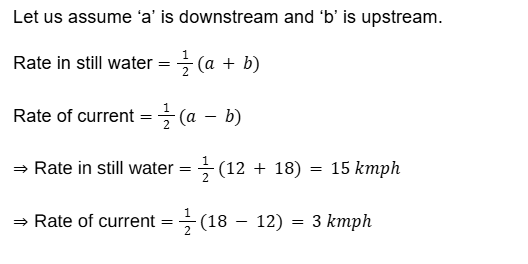
Find the third proportional to 8 and 12?
Find the third proportional to 8 and 12?
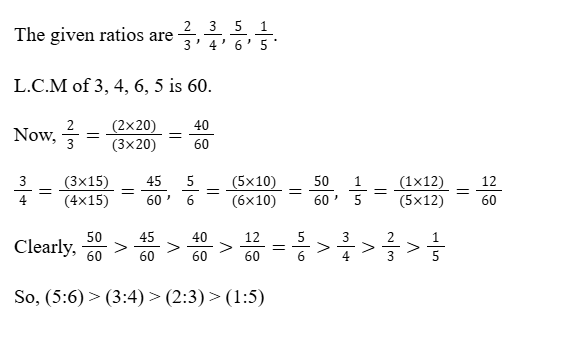
2 : 3, 3 : 4, 5 : 6, 1 : 5


Find the odd word from the list
( Orange, Mandarins, Grapefruit, Pear)
PASSAGE
Tondanuru in Karnataka’s Mandya District, popularly known as Kere Tonnur, has been associated with Sri Ramanujacharya. Tondanuru literally means the place of devotees. It was a flourishing centre of Sri Vaishnava faith and philosophy. Ramanujacharya lived here in the early 12th century and propagated his teachings.
There are over 70 inscriptions found here dating from pre-Hoysala period to the Mysore Wodeyar. Interestingly, a majority of the inscriptions are written in Tamil, in grantha script. It attests to the frequent visits here by Sri Vaishnava devotees from TamilNadu.
The history of Tonnuru can be traced to the prehistoric period as megalithic burial sites have been found in the region. It has been under the control of the gangas of Talakad, Cholas and the Hoysalas and later came under the Vijayanagara, Mysore Wodeyar, and also Hyder Ali and Tipu Sultan. Hoysala chronicles record Tonnura as one of the sub-capital of the period.
The village of Tonnuru in Pandavapura taluk, around 130 km from Bengaluru, is situated amidst fertile paddy fields, coconut groves and a large pond that supplies water for agriculture, with granite hills all around. Local traditions ascribe the excavation of the pond to Ramanujacharya, who also created a channel for water supply.
The religious importance of Tonnur was enhanced by the stay of Sri Ramanujacharya. Tonnuru temples dedicated to the Vaishnavite faith were built or renovated during his presence. It is clear from records that Ramanuja came to Tonnur after Hoysala king Bittiga, who ruled in the 12th century became Vishnuvardhna and an ardent follower of Vishishtadvaita philosophy. Ramanuja’s teachings persuaded many people of the region to become his followers. Later, he moved to Melgate where he stayed for a long period. Sri Yatiraja Dasa became his follower and propagated his teachings.
Question:
The inscriptions found in Tonnuru are of which script?

Consider the disjoint sets S1, S2 and S3 represented above. If Union operation is performed on S1, S2 and S3 what will be the resultant tree if we use Union by Rank method.


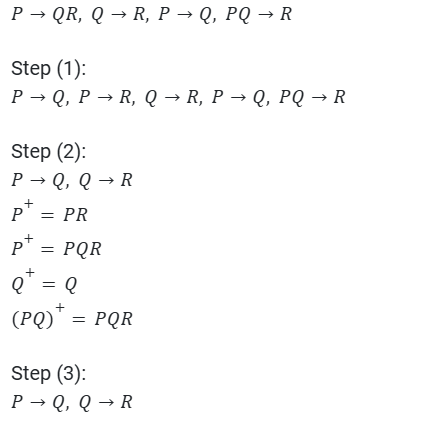
Which of the following statements is always true?
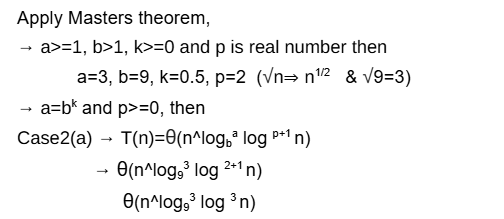
What will be the time complexity for the below recurrence relation?
T(n)=√9T(n/9)+√n log^2 n
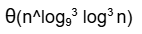
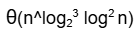
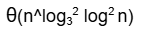
Suppose the secret message contains the following characters with their frequency:
Character
|
P
|
Q
|
R
|
S
|
T
|
U
|
Frequency
|
5
|
10
|
15
|
20
|
23
|
27
|
If the compression technique used is Huffman Coding, how many bits will be saved in the message___(NAT)
Round of upto 3 decimals.
and joint probability mass function
What is the conditional expectation of X given Y = 2?

If the mean of the following probability distribution of a random variable X is 46/9. Which of the following option(s) are correct? , then the variance of the distribution is [MSQ]
Choose the correct answer:

The matrix is


choose the correct option:
 and
and  , find λ such that
  is perpendicular to
  .
.


Find
feature values are given in the below table:
Given a new person(p7 and p8) with feature values, what is the health of these persons by using the Naive Bayes classifier?
Statement I: We use the log of probabilities in the Naive Bayes Classifier because of numerical instability.
Statement II: We use log probabilities in the Naive Bayes Classifier because log(x) is a monotonic function


Let us assume that the black-colored circles represent positive class whereas the white-colored circles represent negative class. Which of the following among H1, H2 and H3 is the maximum-margin hyperplane?
The initial values of x1, x2 and x3 are [10, 5, 5]. The true value of output is 4. If the loss function is mean squared error then what is the value of w1 after the first epoch? Consider initial value of all w1, w2, w3, w4 and w5 as 0.1 and the learning rate is 0.01 (Note: write answer upto 3 decimals)

[MSQ]
No one has climbed every mountain in the Himalayas
Assume that,
person(x) = x is a person
Mountain(y) = y is a mountain in Himalayas
Climb(x,y) = x climbs y
Assume that x belongs to the domain of people and y belongs to the domain of mountains.
Which of the following First Order Logic statements are correct? [MSQ]


def GATE(arr, n):
if n == 1:
return arr[0]
elif arr[n-1] % 2 == 0 and arr[n-1] > 5:
return GATE(arr, n-1) * arr[n-1]
elif arr[n-1] % 2 != 0:
return GATE(arr, n-1) + arr[n-1]
else:
return GATE(arr, n-1) - 2
def GATE(x):
def GATE1(y):
return x * y
return GATE1
def decorator(func):
def wrapper(z):
return func(z + 1) * 2
return wrapper
@decorator
def compute(n):
multiplier = GATE(3)
return multiplier(n)
print(compute(4))
def GATE(n):
if n == 1:
return 1
elif n % 3 == 0:
return GATE(n-1)
else:
return n + GATE(n-1)
print(GATE(6))
class Test:
def _init_(self, value):
self.value = value
def _add_(self, other):
if isinstance(other, Test):
return Test(self.value + other.value)
return self.value + other
def _radd_(self, other):
return self + other
a = Test(10)
b = Test(20)
c = 5 + a + b
print(c.value)
def GATE(a, b):
if b == 0:
return 1
elif b < 0:
return 1 / GATE(a, -b)
else:
return a * GATE(a, b - 1)
print(GATE(2, -3))