The function f : [0, 3] -> [1, 29] defined by f(x) = 2x^3 – 15x^2 + 36x + 1 is
one-one and onto
onto but not one-one
one-one but not onto
neither one-one nor onto
Correct Answer
Option 2
Solution
Difficulty Level: 1
Positive Marks: 1.00
Negative Marks: 0.33
The solution to the above limit is______.
1
-1
0
Does not exist
Correct Answer
Option 4
Solution
Difficulty Level: 1
Positive Marks: 1.00
Negative Marks: 0.33
The range of the function f(x) = 3|sin x| – 2|cos x| is
[-2, √13]
[-2, 3]
[-3, 2]
[3, √13]
Correct Answer
Option 2
Solution
f(x) = 3|sin x| – 2|cos x|
If f(x) is continuous function and |sin x| and |cos x| are always positive.
Find Minimum and Maximum value of f(x):
f(x) is minimum when |sin x| = 0 and |cos x| = 1
The minimum value will be = 0 – 2 = -2
f(x) is max when |sin x| = 1 and |cos x| = 0
The max value will be = 3 – 0 = 3
The required range is [-2, 3].
Difficulty Level: 1
Positive Marks: 1.00
Negative Marks: 0.33
limx→0 (cosec x – cot x)/x is
0.5
Correct Answer
Option 1
Solution
Difficulty Level: 1
Positive Marks: 1.00
Negative Marks: 0.00
Identify Domain and Range of y = x^2
Choose the correct option
domain is (-∞, ∞)
range is y ≥ 0 or [0, ∞)
domain is ( 0 ,- ∞)
all are correct
Correct Answer
Option 1,2
Solution
For domain,
for all real values of x, y exists. So, domain is set of all real number
i.e. domain is (-∞, ∞)
For Range, y = x2 or x = √y . For all y ≥ 0 , x is defined. Thus, y is set of all non-negative and real number.
Hence, range is y ≥ 0 or [0, ∞).
Difficulty Level: 1
Positive Marks: 1.00
Negative Marks: 0.00
If there are three functions, such as f(x) = x, g(x) = 2x and h(x) = 3x. Then find the composition of these functions such as [f ∘ (g ∘ h)] (x) for x = -1
-7
-6
-2
8
Correct Answer
Option 2
Solution
Given,
f(x) = x
g(x) = 2x
h(x) = 3x
To find: [f ∘ (g ∘ h)] (x)
[f ∘ (g ∘ h)] (x) = f ∘ (g(h(x)))
= f ∘ g(3x)
= f(2(3x))
= f(6x)
= 6x
If x = -1, then;
[f ∘ (g ∘ h)] (-1) = 6(-1) = -6
Difficulty Level: 1
Positive Marks: 2.00
Negative Marks: 0.66
If f(x) = x100 + x99 + … + x + 1, then f′(1) is equal to
5050
Correct Answer
Option 1
Solution
f(x) = x100 + x99 + … + x + 1
f′(x) = 100x99 + 99x98 + …. + 1 + 0
f′(1) = 100(1)99 + 99(1)98 + ….+ 1
= 100 + 99 + …. + 1
This is an AP with common difference -1, a = 100, n = 100 and l = 1.
So, the sum of this AP = (100/2)[100 + 1]
= 50(101)
= 5050
Therefore, f′(1) = 5050
Difficulty Level: 1
Positive Marks: 2.00
Negative Marks: 0.00
sec x (x tan x +1)
x tan x + sec x
x sec x + tan x
None
Correct Answer
Option 1
Solution
Difficulty Level: 1
Positive Marks: 2.00
Negative Marks: 0.66
Identify Domain and Range of y = √(9 − x^2)
Choose the correct option [MSQ]
domain is − 3 ≤ x ≤ 3 i.e. [-3, 3]
range is 0 ≤ y ≤ 3 i.e. [0, 3]
Either one correct
Noe
Correct Answer
Option 1,2
Solution
For Domain
For Range
Difficulty Level: 1
Positive Marks: 2.00
Negative Marks: 0.00
sin a
cos a
- sin a
none of the above
Correct Answer
Option 3
Solution
is equal to - sin a
Difficulty Level: 1
Positive Marks: 2.00
Negative Marks: 0.66
168
Correct Answer
Option 1
Solution
Difficulty Level: 1
Positive Marks: 2.00
Negative Marks: 0.00
0
1/3
1/2
1
Correct Answer
Option 2
Solution
Difficulty Level: 1
Positive Marks: 2.00
Negative Marks: 0.00
Find the inverse for the function f(x) = (3x+2)/(x-1)
f^-1(x) = (x+2)/(x-3)
f^-1(x) = (x+1)/(x-3)
both are correct
none of the above
Correct Answer
Option 1
Solution
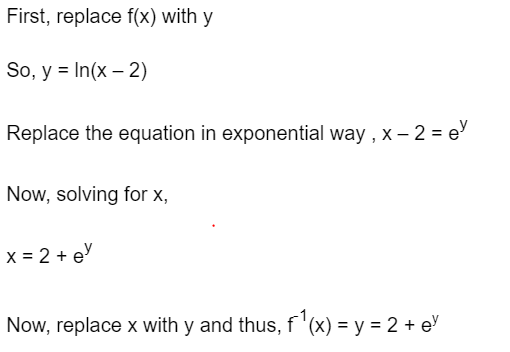
First, replace f(x) with y and the function becomes,




 is equal to - sin a