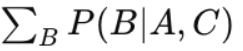
Bayes' rule is a fundamental principle in Bayesian inference, which states that P(A|B)=P(B|A)*P(A)/P(B). This formula updates our prior probability distribution over A given B with new evidence B, resulting in a posterior probability distribution over A.
Difficulty Level: 1
Positive Marks: 1.00
Negative Marks: 0.33
Which of the following is NOT a use case for Bayesian Networks?
Predictive modeling
Classification
Feature selection
Time series forecasting
Correct Answer
Option 3
Solution
Feature selection (Feature selection is typically performed using other methods, such as filter methods or wrapper methods)
Difficulty Level: 1
Positive Marks: 1.00
Negative Marks: 0.33
Suppose we have a Bayesian Network with a plate (i.e., a set of nodes that share a common probability distribution). How does the plate affect the computation of the posterior probability distribution?
It reduces the number of nodes in the network
It increases the number of nodes in the network
It has no effect on the number of nodes in the network
It depends on the specific plate and nodes
Correct Answer
Option 2
Solution
It increases the number of nodes in the network
Difficulty Level: 1
Positive Marks: 1.00
Negative Marks: 0.33
Suppose we have a Bayesian Network with a noisy-OR gate as its conditional probability distribution. How does this gate affect the behavior of the network?
It reduces the probability of the output node
It increases the probability of the output node
It has no effect on the probability of the output node
It depends on the specific noisy-OR gate
Correct Answer
Option 2
Solution
It increases the probability of the output node
Difficulty Level: 1
Positive Marks: 1.00
Negative Marks: 0.33
Suppose we have a Bayesian Network with a cycle (i.e., a node that points back to itself). Which algorithm can be used to perform inference on this network?
Exact inference
Approximate inference
Belief propagation
Gibbs sampling
Correct Answer
Option 4
Solution
Gibbs sampling
Difficulty Level: 1
Positive Marks: 1.00
Negative Marks: 0.33
Which of the following is a characteristic of a Bayesian Network?
It is a directed acyclic graph (DAG)
It is an undirected graph
It is a probabilistic graphical model
It is a neural network
Correct Answer
Option 1
Solution
It is a directed acyclic graph (DAG)
Difficulty Level: 1
Positive Marks: 2.00
Negative Marks: 0.66
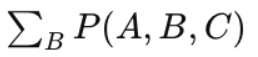
Consider a Bayesian Network with three variables A, B, and 𝐶 where
A→B and B→C. How would you marginalize B out from the joint distribution
P(A,B,C)?
Correct Answer
Option 2
Solution
Difficulty Level: 1
Positive Marks: 2.00
Negative Marks: 0.66
In the variable elimination algorithm, when eliminating a variable XXX, which of the following operations is required on the factors that depend on XXX?
Marginalization
Normalization
Multiplication
Addition
Correct Answer
Option 1
Solution
In variable elimination, when eliminating a variable XXX, you marginalize it out by summing over all its possible values in the factors that depend on it.
Difficulty Level: 1
Positive Marks: 2.00
Negative Marks: 0.66
When performing Gibbs sampling, which of the following is the key challenge in achieving convergence to the correct distribution?
Ensuring the variables are conditionally independent.
Sampling from the exact marginal distribution
Dealing with variables that have complex conditional distributions.
Handling high-dimensional joint distributions.
Correct Answer
Option 3
Solution
Gibbs sampling relies on the ability to sample from conditional distributions. When these conditional distributions are complex or difficult to compute, it can be challenging to achieve convergence.
Difficulty Level: 1
Positive Marks: 2.00
Negative Marks: 0.66
Suppose you have a Bayesian Network with two variables X and
Y, where X→Y. If you are given P(X)=0.3 and P(Y=1∣X=0)=0.2, P(Y=1∣X=1)=0.8, what is
P(Y=1)? (Upto 2 decimals)
0.56
Correct Answer
Option 1
Solution
P(Y=1)=P(Y=1∣X=0)P(X=0)+P(Y=1∣X=1)P(X=1)
P(Y=1)=0.2×0.7+0.8×0.3=0.14+0.24=0.56
Difficulty Level: 1
Positive Marks: 2.00
Negative Marks: 0.66
What is the purpose of hybrid MCMC in Gibbs Sampling?
To reduce computational complexity
To improve convergence rate
To reduce variance of estimates
To increase precision of estimates
Correct Answer
Option 2
Solution
Hybrid MCMC is used to improve convergence rate by combining different MCMC algorithms to adapt to changing problem characteristics.
Difficulty Level: 1
Positive Marks: 2.00
Negative Marks: 0.66
What is the purpose of importance sampling in Gibbs Sampling?
To reduce computational complexity
To improve convergence rate
To reduce variance of estimates
To increase precision of estimates
Correct Answer
Option 3
Solution
Importance sampling is used to reduce variance of estimates by weighting samples based on their importance.
Difficulty Level: 1
Positive Marks: 2.00
Negative Marks: 0.66
Which of the following is a common technique used in Gibbs Sampling to improve convergence?
Tempering
Annealing
Adaptive MCMC
Importance sampling
Correct Answer
Option 2
Solution
Adaptive MCMC is a common technique used in Gibbs Sampling to improve convergence by adjusting the proposal distribution based on past simulations.
Difficulty Level: 1
Positive Marks: 2.00
Negative Marks: 0.66
What is the purpose of the Metropolis-Hastings algorithm in Gibbs Sampling?
To propose new values for each variable
To accept or reject proposed values for each variable
To compute the exact posterior distribution
To eliminate variables from the network
Correct Answer
Option 2
Solution
The Metropolis-Hastings algorithm is used to accept or reject proposed values for each variable in Gibbs Sampling.
Difficulty Level: 1
Positive Marks: 2.00
Negative Marks: 0.66
What is the purpose of the burn-in period in Gibbs Sampling?
To discard initial samples that are not representative of the target distribution
To compute the exact posterior distribution
To eliminate variables from the network
To compute the joint probability distribution of a Bayesian Network
Correct Answer
Option 1
Solution
The burn-in period is used to discard initial samples that are not representative of the target distribution.