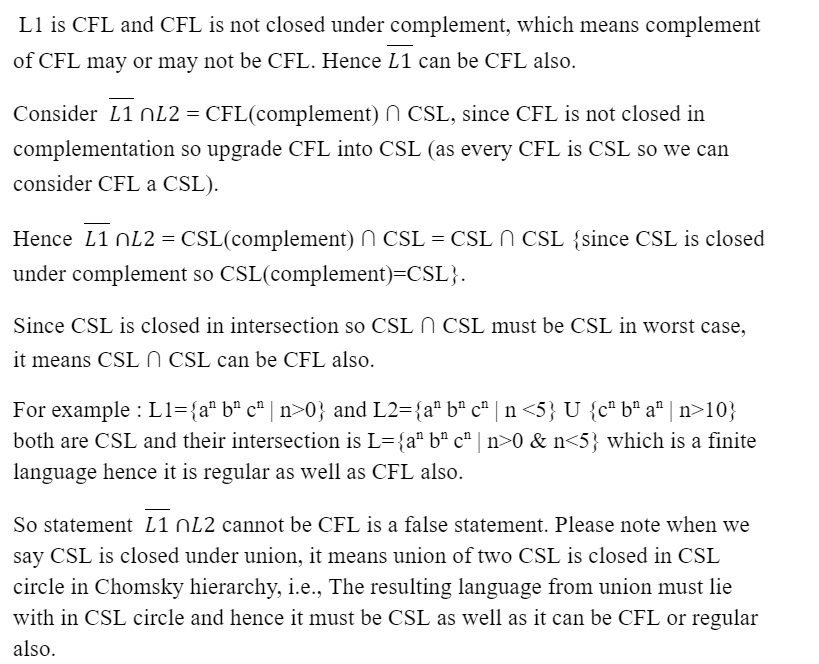
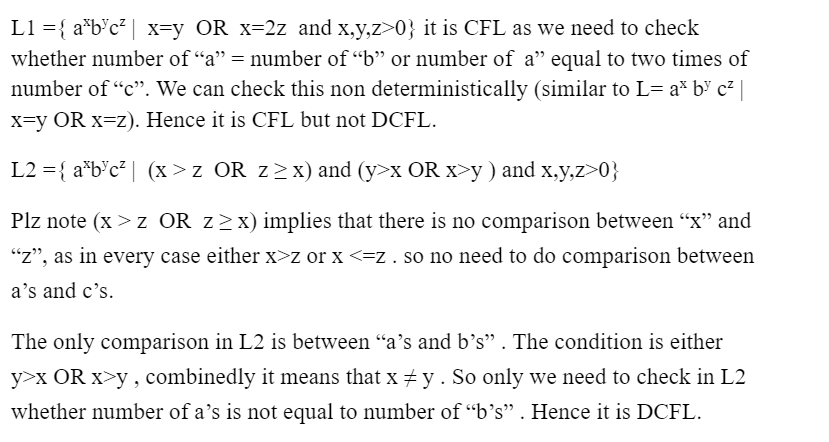
Consider the following DFA and select the correct option with reference to DFA.
S1: Every proper subset of a context free language is regular.
S2: Every finite subset of a recursive enumerable language is context free.
Select the correct option
Select the correct grammar generating L from options.
L1={wxn yn wr | w ϵ{a,b}* & n>0}
L2={xnwwr yn | w ϵ{a,b}* & n>0}
Select the correct option.
L1={a^n a^m b^n b^m | n,m > 0}
L2={a^n a^m b^m b^n | n,m > 0}
Select the correct option.
L1={a^n b^m | n=m &n,m >=0}
L2={a^n b^m | n≠m &n,m >=0}
Select the option which is not true.


S1: Every language accepted by DPDA can also be accepted by NPDA.
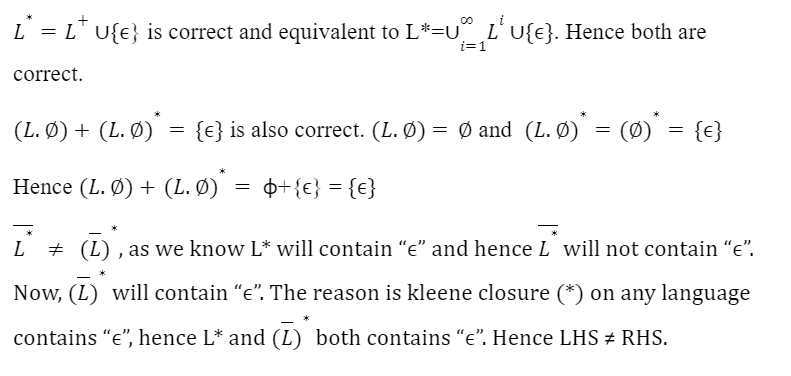
S2: If a language is accepted by finite automata then the subset of language must also be accepted by finite automata.
Select the correct option.
S1: A Turing machine accepting a recursively enumerable language may go to infinite loop for any string “w” belongs to language.
S2: A Turing machine accepting a recursive language will never go into infinite loop.
Select the correct option.
Select the correct transition in place of P and Q from the options.
P1: A NFA M1 is equivalent to another NFA M2.
P2: A NFA M1 accepts the same language generated by regular expression R1.
Select the correct option.
Select the correct option.
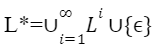
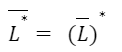
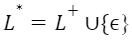

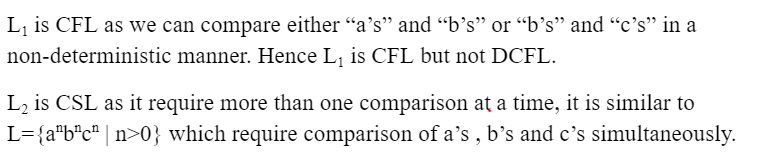
L1 ={a^p b^q c^r | p=q or q≠r}
L2={ a^p b^q c^r | p=q and q>r}
Select the correct option.
S→AB
A→aAa |ϵ
B→bBb |ϵ
Select the correct option about the grammar.
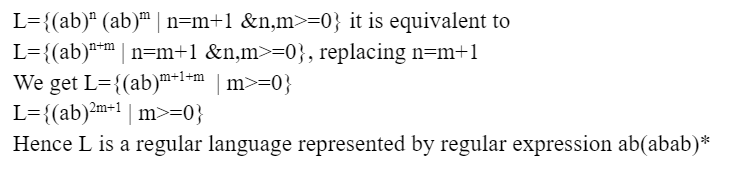
LA ={wXw^r | w,X ϵ{a,b}+ }
LB ={Xww^r | w,X ϵ{a,b}* }
Select the correct option.



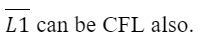
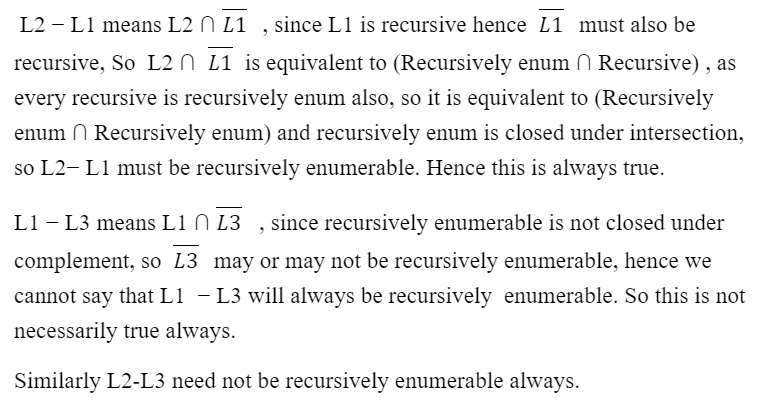
L1={a^n | n>=0} , L2={b^n |n>=0} and L3={c^n | n>=0}
Consider a new language L = L1.L2.L3
Select the correct option.
S1: Whether a given Turing machine accept empty language.
S2: Whether a given Turing machine accept finite language.
Select the correct options.
S1: Whether a given Turing machine accept regular language.
S2: Whether a given Turing machine accept universal language.
Select the correct options.