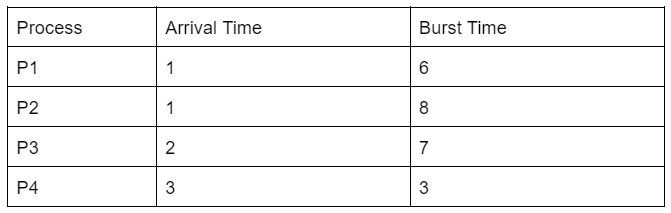
Consider the following process information:

Using FCFS scheduling the average waiting time is ________ units.
Using FCFS scheduling the average waiting time is ________ units.
Using RR scheduling (time quantum 2 units) the average turnaround time is ________ units.
Using SJF scheduling the average waiting time is ________ units.
Using SRTF scheduling the average waiting time is ________ units.
Using HRRN scheduling the average waiting time is ________ units
Consider the following processes arrive at time 0 in that order ( process 1,2,3,4) with given information. The priority (lowest number is treated as high priority) is used only for Priority scheduling algorithm or as tie breaker
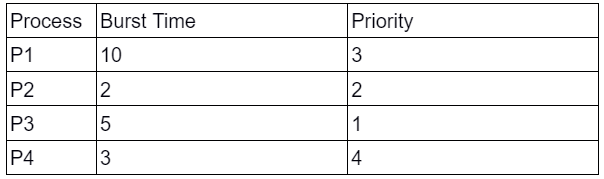
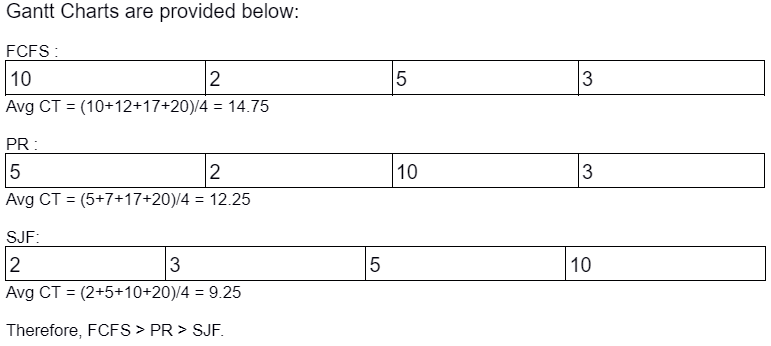
Assuming no context switch overhead, which of the following is the correct order according to the average completion time for First Come First Serve (FCFS), Shortest Job First (SJF) and Priority Scheduling (PR)?
Consider the following processes arrive at time 0 in that order ( process 1,2,3,4) with given information.
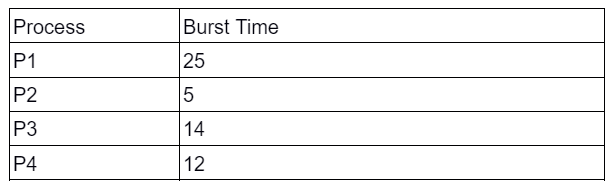
A round robin scheduling algorithm is used with an initial time quantum of 5 units. The round robin algorithm has no context switch overhead and the time quantum of each process is doubled every cycle (each cycle is complete when each process passes through the ready queue and comes back to ready queue again, i.e, READY -> RUNNING -> READY), the completion time of process P3 is :
Assume four processes A, B, C and D with burst time a, b, c and d, respectively arrive at same time in that order. The relation between burst times are a<d<c<b. With no context switch delay involved the average turn around time using SJF scheduling algorithm is :
Consider the following process information table. The average waiting time (AvgWT) and average turnaround time (AvgTAT), using SRTF scheduling algorithm are :