Consider a system with 2KB page size and a process of size 72,766 bytes. The total internal fragmentation that could be possible, if the process is completely allocated the memory is_____________ bytes
962
Difficulty Level: 1
Positive Marks: 1.00
Negative Marks: 0.00
Which of the following are correct about Threads?
A thread has no data segment.
Each thread has its own stack.
There can be more than one thread in a process.
Each thread has its own heap.
Difficulty Level: 1
Positive Marks: 1.00
Negative Marks: 0.00
Which of the following information about the process is identical for a parent and the newly created child processes, immediately after the fork system call?
The process id (PID)
The file descriptor (fd) opened by the parent
Both of these.
None of these
Difficulty Level: 1
Positive Marks: 1.00
Negative Marks: 0.33
Which of the following are TRUE regarding Wait-for Graphs?
In a single instance resource system, cycles in the wait-for graph indicate deadlocks.
A wait-for graph is used for deadlock detection.
A wait-for graph can be constructed from a resource-allocation graph.
In a single instance resource system, cycles in the wait-for graph may not indicate deadlocks.
Difficulty Level: 1
Positive Marks: 1.00
Negative Marks: 0.00
Degree of multiprogramming is controlled by?
Medium term scheduler
Long term scheduler
Short term schedule
None of these
Difficulty Level: 1
Positive Marks: 1.00
Negative Marks: 0.33
Consider a hard disk of capacity 1GB, and a block size of 1KB. If the free space list is maintained as a bitmap, then the size of the bitmap is
1MB
1Mb
1Kb
1KB
Difficulty Level: 1
Positive Marks: 1.00
Negative Marks: 0.33
An operating system contains 3 user processes each requiring 2 units of resource R. The minimum number of units of R such that no deadlock will ever occur is_______
1
2
3
4
Difficulty Level: 1
Positive Marks: 1.00
Negative Marks: 0.33
Compaction is
a technique for overcoming internal fragmentation
a paging technique
a technique for overcoming external fragmentation
a technique for overcoming fatal error during execution.
Difficulty Level: 1
Positive Marks: 1.00
Negative Marks: 0.33
Which of the following is added to the page table in order to track whether a page of cache has been modified since it was read from the memory?
Reference bit
Dirty bit
Tag Bit
Valid Bit
Difficulty Level: 1
Positive Marks: 1.00
Negative Marks: 0.33
Working set(t,k) at an instant of time t,is
The set of k future references that the operating system will make
The set of future references that the operating system will make in the next ’k’ time units
The set of k references with high frequency
The set of pages that have been referenced in the last k time units
Difficulty Level: 1
Positive Marks: 1.00
Negative Marks: 0.33
Determine the number of page faults when references to pages occur in order

1, 2, 4, 5, 2, 1, 2, 4.

Assume that the main memory can accommodate 3 pages and the main memory already has the pages 1 and 2, with page 1 having been brought earlier than page 2.(assume LRU algorithm is used)

3
4
5
6
Difficulty Level: 1
Positive Marks: 1.00
Negative Marks: 0.33
Which of the following is TRUE?
The four conditions that must hold in order for deadlock to occur are: Hold-and-wait,circular-wait,starvation and mutual exclusion.
The main advantage of multilevel page tables is that they use page table memory efficiently.
Starvation implies deadlock.
Shortest Job First is the optimal scheduling algorithm, but it is generally not implemented directly, due to excessive context switching overhead.

Difficulty Level: 1
Positive Marks: 1.00
Negative Marks: 0.33
A counting semaphore was initialized to 10. Then 12 P (wait) operations and 10V (signal) operations were completed on this semaphore. The resulting value of the semaphore is
0
8
10
12
Difficulty Level: 1
Positive Marks: 1.00
Negative Marks: 0.33
Consider the following synchronization mechanism and choose the appropriate answer :

It works on single CPU machines because it disables context switches within the critical region.
It works on single CPU machines even when there are context switches within the critical region.
It does not work on single core CPU.
None of these.
Difficulty Level: 1
Positive Marks: 1.00
Negative Marks: 0.33
Consider the following six I/O operations and their respective cylinder locations on disk. Seek time is 0.1ms per cylinder traversed and the arm begins at cylinder 33.

(A:4), (B:10), (C:35), (D:62), (E:69), (F:95)

Using the Shortest Seek Time First disk scheduling algorithm to schedule these operations, find the total seek time (in ms).

12
12.4
11.5
15
Difficulty Level: 1
Positive Marks: 1.00
Negative Marks: 0.33
Consider a file system with 4096 byte blocks and 32-bit disk and file block pointers. Each file has 13 direct pointers, 4 singly-indirect pointers, a doubly-indirect pointer, and a triply-indirect pointer. The number of i-nodes that can fit in a single block are............
54
53
127
128
Difficulty Level: 1
Positive Marks: 1.00
Negative Marks: 0.33
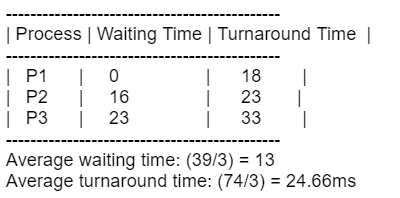
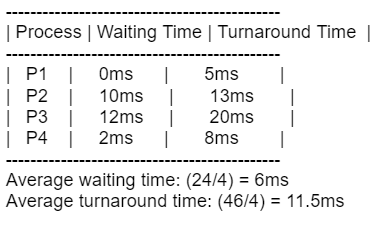
Consider the following process information table. The average waiting time (AvgWT) and average turnaround time (AvgTAT), using FCFS scheduling algorithm are, (where the process with lower process-id is scheduled first, in case of tie):

AvgWT= 13 , AvgTAT = 24.66
AvgWT= 13.25, AvgTAT = 24
AvgWT= 13.25, AvgTAT = 24.25
AvgWT= 18.75 , AvgTAT = 24
Difficulty Level: 1
Positive Marks: 2.00
Negative Marks: 0.66
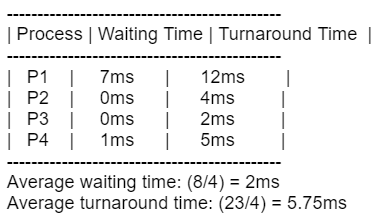
Consider the following process information table. The average waiting time (AvgWT) and average turnaround time (AvgTAT), using SJF scheduling algorithm are :

AvgWT= 2.25 , AvgTAT = 5.25
AvgWT= 2, AvgTAT = 5.75
AvgWT= 2.25, AvgTAT = 5.5
AvgWT= 1.75 , AvgTAT = 5.25
Difficulty Level: 1
Positive Marks: 2.00
Negative Marks: 0.66
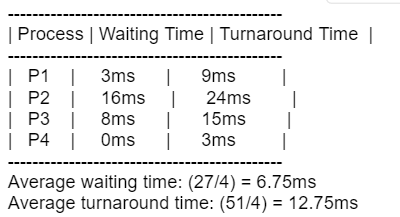
Consider the following process information table. The average waiting time (AvgWT) and average turnaround time (AvgTAT), using SRTF scheduling algorithm are :

AvgWT= 6.25 , AvgTAT = 12.25
AvgWT= 6, AvgTAT = 12
AvgWT= 6.25, AvgTAT = 12.25
AvgWT= 6.75 , AvgTAT = 12.75
Difficulty Level: 1
Positive Marks: 2.00
Negative Marks: 0.66
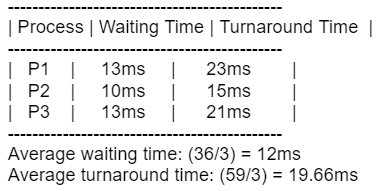
Consider the following process information table. The average waiting time (AvgWT) and average turnaround time (AvgTAT), using Round Robin scheduling algorithm with time quantum 2 units are :

AvgWT= 12.25 , AvgTAT = 19.25
AvgWT= 12, AvgTAT = 19.66
AvgWT= 12.25, AvgTAT = 19.33
AvgWT= 12.75 , AvgTAT = 19.66
Difficulty Level: 1
Positive Marks: 2.00
Negative Marks: 0.66
Consider the following process information table. The average waiting time (AvgWT) and average turnaround time (AvgTAT), using Non-preemptive Priority scheduling algorithm are (higher priority number indicates high priority.) :\

AvgWT= 6.25 , AvgTAT = 11.25
AvgWT= 6.5, AvgTAT = 11
AvgWT= 6, AvgTAT = 11.5
AvgWT= 6.75 , AvgTAT = 11
Difficulty Level: 1
Positive Marks: 2.00
Negative Marks: 0.66
Consider a system with 1KB page size and single-level paging is used. The virtual address space is 36 bits and the physical address space is 32 bits. Calculate the number of frames required to store the entire page table.
2^18
2^20
2^26
2^28
Difficulty Level: 1
Positive Marks: 2.00
Negative Marks: 0.66
Consider a system with 4KB page size and 3-level paging is used. The virtual address space is 36 bits and the physical address space is 32 bits. The page table entry at every level is 16bytes.The number of frames required to store all the level page tables, if each level uses 8 bits for page table indexing and each page table fits one page-frame_____________
65539
Difficulty Level: 1
Positive Marks: 2.00
Negative Marks: 0.00
Consider the following code in which the integer is of size 4 bytes and the page size is 4KB, and on demand paging is used with 3 frames initially empty. The number of page faults generated by the code using a FIFO page replacement policy is:_______

int A[4000];

int main()

{

for(i=0;i<4000;i++){ //Row major order access

A[i] = A[i]+1;

}

return 0;

}

4
Difficulty Level: 1
Positive Marks: 2.00
Negative Marks: 0.00
Which of the following are the advantages of dynamic linked libraries? [MSQ]

The executable is smaller
When the library is changed, the code that references it does not usually need to be recompiled.
Every loaded program contains a duplicate copy of library routines.
Multiple programs can access the same library at the same time.
Difficulty Level: 1
Positive Marks: 2.00
Negative Marks: 0.00
Which of the following are correct about Threads? [MSQ]

Threads in a process can execute different parts of the program code at the same time.
Threads can also execute the same parts of the code at the same time, but with different execution state.
Processes start out execution with a single main thread.
A thread can also create new threads.
Difficulty Level: 1
Positive Marks: 2.00
Negative Marks: 0.00
Choose the correct statement(s) among the following: [MSQ]

Paging eliminates the problem of external fragmentation and therefore the need for compaction.
Paging allows sharing of code pages among processes, reducing overall memory requirements.
Paging enables processes to run when they are only partially loaded in main memory.
Paging reduces the memory access overhead.
Difficulty Level: 1
Positive Marks: 2.00
Negative Marks: 0.00
Which of the following are TRUE regarding the priority inversion problem? [MSQ]

Priority inversion may occur from resource synchronization among processes of different priorities.
Test-andSet lock suffers from priority inversion problems.
Priority inversion may lead to starvation.
Priority inversion problem may occur in any preemptive scheduling algorithms.
Difficulty Level: 1
Positive Marks: 2.00
Negative Marks: 0.00
Consider the following code using mutex M1=1,M2=1, and M3=1.

Which of the following are correct ? [MSQ]

Mutual exclusion is satisfied.
Deadlock is possible only when all three resources (M1, M2 and M3) are held by processes.
Deadlock is not possible.
Deadlock is possible if only two resources out of M1, M2 and M3 are held by processes.
Difficulty Level: 1
Positive Marks: 2.00
Negative Marks: 0.00
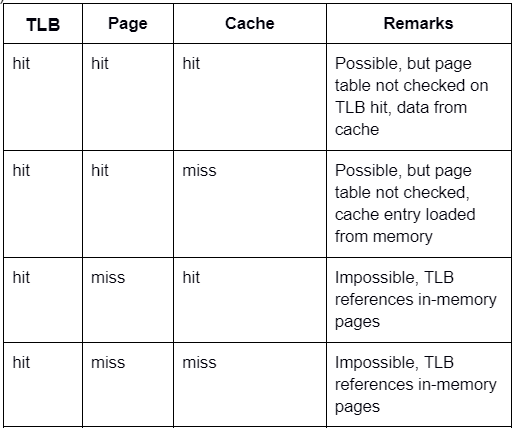
Consider the following combinations and identify which of the following are possible? [MSQ]

TLB: Hit, Page: Hit, Cache: Hit
TLB: Hit, Page: Hit, Cache: Miss
TLB: Miss, Page: Miss, Cache: Hit
TLB: Miss, Page: Miss, Cache: Miss
Difficulty Level: 1
Positive Marks: 2.00
Negative Marks: 0.00
Consider a paging system that uses 2-level page table residing in main memory and a TLB for address translation. Each main memory access takes 200 ns and TLB lookup takes 20 ns. The page fault service takes 10000 ns. Assume that the TLB hit ratio is 99%, page fault rate is 1%. TLB update time is negligible. To make the memory access faster, a physical level-1 cache is introduced, with no update mechanism. The cache access time is 150 ns, with a cache hit rate of 95%, and the page tables are not cached. The effective memory access time in ns (round off to 2 decimal places) is ___________ .
186.35
Difficulty Level: 1
Positive Marks: 2.00
Negative Marks: 0.00
Which of the following are TRUE? [MSQ]

Lock variable synchronization mechanism ensures mutual exclusion.
Strict alternation synchronization mechanism ensures progress.
Peterson's Solution synchronization mechanism ensures bounded waiting.
Test-and-Set lock synchronization mechanism may suffer from deadlock.
Difficulty Level: 1
Positive Marks: 2.00
Negative Marks: 0.00
Consider the following code, which is shared by four concurrent processes.

int count = 0, n=10; //Shared among all processes

int main()

{

int i; // local to each process

for(i=1;i<=n;i++){

count=count+1;

}

return 0;

}

The minimum value of count after completion of execution is

1
2
10
40
Difficulty Level: 1
Positive Marks: 2.00
Negative Marks: 0.66