Consider the following language L such that
L={ w | w ∈ {a,b}* & w is any string not in (a* U b*) }
The minimum number of states in the DFA which accepts L are ____
L={ w | w ∈ {a,b}* & w is any string not in (a* U b*) }
The minimum number of states in the DFA which accepts L are ____
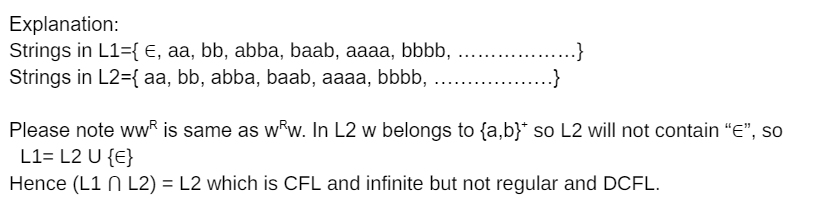
L1: { ww^R | w ∈ {a,b}* }
L2: { w^Rw | w ∈ {a,b}+ }
Consider a new language L3 such that L3= (L1 ⋂ L2). Select the correct option about L3.
R1: (a+b)* a (a+b)* a (a+b)*
R2: (a+b)* aa (a+b)*
Select the correct option.
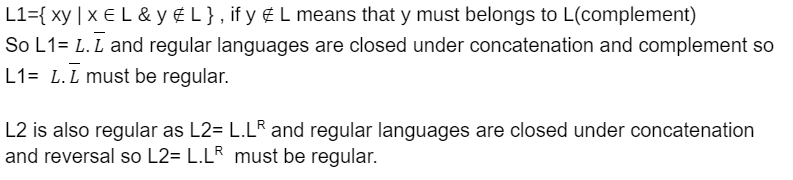
L1={ xy | x ∈ L & y ∉ L }
L2={ xy | x ∈ L & y ∈ L^R, where LR is the reverse of L}
Select the correct option
Pumping lemma says that:
For any language L, there exists an integer p (p is the pumping length), such that for all x ∈ L with |x| ≥ p, there exists u,v, w ∈ Σ*, such that x = uvw, and
(1) |uv| ≤ p
(2) |v| ≥ 1
(3) for all i ≥ 0: uv^i w ∈ L
Consider the regular language L given by regular expression: bab*aa. The minimum pumping length for language L will be

while(x < 2021)
{
val += x--;
printf(“Value =%d \n”, val);
}
Select the correct statement from the option.
S→ Xa | bXc | dc | bda
X→d
Select the correct option.
[Spilling is the action consists of storing a variable into memory instead of registers]
Consider the above graph. Which among the following is correct BFS traversal ?
R= {(2,3),(3,4),(4,1),(1,3),(3,2)} Then the inverse of R is
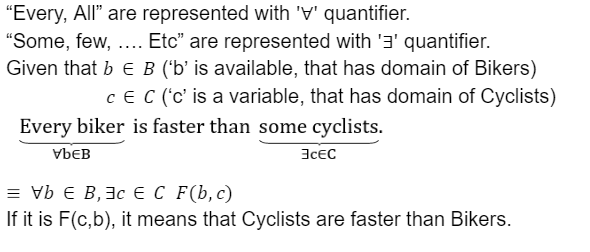
The correct expression of the sentence “ Every biker is faster than some cyclist “ is




Consider the following memory reference string :
1,2,3,4,5,3,4,1,6,7,8,7,8,9,7,8,9,5,4,5,4,2
Calculate the average memory access time if memory access time is 100ns and 3000ns page fault service time if on demand Optimal page replacement algorithm is used with a total physical memory of 4 frames.
Bob(int n)
{
if(n<2)
return;
else
{
sum=0;
for(i=1; i<=4; i++)
Bob(n/2);
for(i=1; i<=n ; i++)
sum=sum+1;
}
}
Assume that the division operation takes constant time and “sum” is a global variable. What is the time complexity of “Bob(n)”?
Assume node ‘S’ is the starting vertex for prim’s algorithm, Which of the following can be the correct order of edges in which they are added to construct the minimal spanning tree?
P: Every directed acyclic graph has exactly one topological ordering.
Q: Given a graph G = (V,E) with positive edge weights, the Bellman-Ford algorithm and Dijkstra’s algorithm can produce different shortest-path trees despite always producing the same shortest-path weights.
R: Dijkstra’s algorithm may not terminate if the graph contains negative-weight edges.
S: If a topological sort exists for the vertices in a directed graph, then a DFS on the graph will produce no back edges.
void main()
{
char c='5';
int a=3,b=2;
printf("%d", a+b+c);
}
Note: ASCII value of ‘5’ is 53