Consider the following finite automata

Select the correct regular expression for the given finite automata

a*bb*a(a+b)*
a*bb*
aa*+ ϵ
None of the above
Difficulty Level: 1
Positive Marks: 1.00
Negative Marks: 0.33
Consider the following language given by regular expression R: a*+(ab)*. The number of states in the minimal NFA which accepts language generated by regular expression R is __________
4
Difficulty Level: 1
Positive Marks: 1.00
Negative Marks: 0.00
Consider the following finite automata. [MSQ]


Select the correct option.

The given FA accepts the language which contains all strings which start and end with the same symbol.
The given FA is a minimal DFA
The language accepted by finite automata is co-finite.
If A is also the final state then FA accepts universal language over alphabet {a,b}
Difficulty Level: 1
Positive Marks: 1.00
Negative Marks: 0.00
Consider the following languages L1 and L2 and select the correct option.

L1={a^i b^j c^k | i=j or j=k}

L2={a^i bj ck | i=j or i=k}

Both are DCFL.
Both are CFL but not DCFL.
L1 is DCFL and L2 is CFL but not DCFL.
L1 is CFL but not DCFL and L1 is DCFL.
Difficulty Level: 1
Positive Marks: 1.00
Negative Marks: 0.33
Consider the following deterministic context free languages L1and L2.

L1={ a^n b^n | n > 0}

L2={ b^n a^n | n > 0}

The language L1 U L2 must be

Regular
DCFL but not regular
CFL but not DCFL
Finite
Difficulty Level: 1
Positive Marks: 1.00
Negative Marks: 0.33
Consider the following problems

P1: The concatenation of recursive enumerable language with empty language is recursive.

P2: The union of non recursively enumerable language with its complement is a recursive language.

Select the correct option.

Both P1 and P2 are decidable.
Both P1 and P2 are undecidable.
P1 is decidable but P2 is undecidable.
P1 is undecidable but P2 is decidable.
Difficulty Level: 1
Positive Marks: 1.00
Negative Marks: 0.33
The number of 3 states {assume states A,B,C} DFA's which can be constructed with a designated initial and final state that accepts empty language over alphabet {a, b} is _______
189
Difficulty Level: 1
Positive Marks: 2.00
Negative Marks: 0.00
Consider the following languages L1 and L2 and select the correct option.

L1={a^i b^j | i=kj for some positive integer k}

L2={a^i b^j | i=2j }

Both are CFL.
Both are CSL but not CFL.
L1 is CSL but not CFL and L2 is CFL but not DCFL.
L1 is CSL but not CFL and L2 is DCFL but not regular.
Difficulty Level: 1
Positive Marks: 2.00
Negative Marks: 0.66
Consider the following equalities (R1 and R2) of regular expressions.

R1: (a* b* )* = ∊ + (a+b+ )+

R2: (a* + b* )* = ∊ + (a+ + b+ )+

select the correct option.

Both R1 and R2 are correct.
Both R1 and R2 are wrong.
R1 is correct but R2 is wrong.
R1 is wrong and R2 is correct
Difficulty Level: 1
Positive Marks: 2.00
Negative Marks: 0.66
Consider the language L over ∑={a,b} in which every string ends with at least one “a”. The operation “DelEnd” removes the rightmost symbol from any string. For example, DelEnd(babba) = “babb”. The operation can be extended to the languages by the definition, DelEnd(L)={DelEnd(w) : w ϵ L}

Select the correct option.

In language generated by DelEnd(L) no string will end with “a”.
The min DFA of DelEnd(L) will have two states.
DelEnd(L) is the superset of language L.
L ∩ DelEnd(L) = DelEnd(L)
Difficulty Level: 1
Positive Marks: 2.00
Negative Marks: 0.66
Select the wrong statement from the given options.
If L is a CFL then L= φ is decidable but L=∑* is undecidable.
If L is a CSL then α ϵ L (where α is any string from ∑) is decidable but L= φ is undecidable.
If L is a recursive then α ϵ L (where α is any string from ∑) is decidable but L= φ is undecidable.
If L is a recursively enumerable language then α ϵ L is decidable but β L is undecidable, (where α and β are any string from ∑).
Difficulty Level: 1
Positive Marks: 2.00
Negative Marks: 0.66
Consider the following PDA, where A is initial state and C is final state.

The language accepted by the given PDA is:

L={a^x b^yc^x | x,y >0}
L={a^x b^y c^z | x,y,z >=0 & x>=(y+z)}
L={a^x b^y c^z | x,y,z >0 & x>=(y+z)}
None of the above
Difficulty Level: 1
Positive Marks: 2.00
Negative Marks: 0.66
Consider the following CFG given below:

S→SPQR

P→pPt | ε

Q→qQ | ε

R→Rr | Qm | ε

Number of elements in FOLLOW(P) is: ___

6
Difficulty Level: 1
Positive Marks: 1.00
Negative Marks: 0.00
Consider the following grammar and select the correct option about precedence and associativity between operators as per the given grammar. [MSQ]

S → S+T | T

S → T*S | T

T → T % T

T → F

F → F − Z | Z

Z → id

* is having more precedence than + and * is right associative.
% is having more precedence than * and + is left associative.
+ and * have the same precedence but both have less precedence than % operator.
− is having highest precedence and − is left associative
Difficulty Level: 1
Positive Marks: 1.00
Negative Marks: 0.00
Consider the following grammar, where {x,y} are terminals and {S} are non terminal. [MSQ]

S →Sy| xSy | 𝟄

Select the correct option.

The grammar is ambiguous
The grammar is not LALR(1)
The grammar is CLR(1)
The grammar is LL(1)
Difficulty Level: 1
Positive Marks: 1.00
Negative Marks: 0.00
Consider the following grammar [MSQ]

S → SS + | SS*| a

Select the correct option.

The grammar is unambiguous
The grammar is LL(1)
The grammar is SLR(1)
The grammar is CLR(1) but not LALR(1)
Difficulty Level: 1
Positive Marks: 2.00
Negative Marks: 0.00
Consider the following grammar along with the actions specified in bracket. A SR parser carried out the parsing and the actions specified immediately after reducing the corresponding rule.

S-> ppA {“print *”}

S->q {“print #”}

A->Sr {“print $”}

A->r {“print &”}

Select the correct translation of “ppppqrr” from the given options:

#$*$*
*$*$#
*$#$*
#$*$&
Difficulty Level: 1
Positive Marks: 2.00
Negative Marks: 0.66
If there is a large number of _______ then it may be difficult to achieve multi-programming.
I/O devices
I/O-bound processes
CPU-bound processes
none
Difficulty Level: 1
Positive Marks: 1.00
Negative Marks: 0.33
If time quantum is too short in RR scheduling, then it suffers from
high waiting time
high turnaround time
high context switch time
none
Difficulty Level: 1
Positive Marks: 1.00
Negative Marks: 0.33
___________eliminates unnecessary seek operations and thereby increases average response time.
SCAN
FIFO
LOOK
SSTF
Difficulty Level: 1
Positive Marks: 1.00
Negative Marks: 0.33
A process while executing may reach an instruction where it has to wait for some I/O devices or some other event. Its state becomes
wait state
blocked state
running state
none
Difficulty Level: 1
Positive Marks: 1.00
Negative Marks: 0.33

Consider the following information about the processes :

Process

Arrival Time

Burst Time

P1

0

3

P2

2

6

P3

4

4

P4

6

5

P5

8

2

Calculate the average normalized turn around time using SJF scheduling algorithm

2.56
2.71
1.84
1.59
Difficulty Level: 1
Positive Marks: 2.00
Negative Marks: 0.66

Consider the following information about the processes :

Process

Arrival Time

Burst Time

P1

0

3

P2

2

6

P3

4

4

P4

6

5

P5

8

2

Calculate the average normalized turn around time using SRTF scheduling algorithm

2.56
2.71
1.84
1.59
Difficulty Level: 1
Positive Marks: 2.00
Negative Marks: 0.66

Consider the following information about the processes :

Process

Arrival Time

Burst Time

P1

0

3

P2

2

6

P3

4

4

P4

6

5

P5

8

2

Calculate the average normalized turn around time using HRRN scheduling algorithm

2.14
2.71
1.84
1.59
Difficulty Level: 1
Positive Marks: 2.00
Negative Marks: 0.66

Consider a machine where a page size is 256 words and a frame number is mapped to a page number 4 times lesser. What is the physical address corresponding to logical address

0001010010111010?

0000010110111011
0010010110111011
0001010110111011
0001010010111010
Difficulty Level: 1
Positive Marks: 2.00
Negative Marks: 0.66
Consider a system with two-level paging with TLB. The TLB access time is 15ns and main memory access time is 100ns. If the TLB hit rate is 95% then what is the effective memory access time.
120ns
125ns
130ns
135ns
Difficulty Level: 1
Positive Marks: 2.00
Negative Marks: 0.66
Which of the following flip-flops suffers from race-around condition?
JK flip-flop
SR flip-flop
T flip-flop
D flip-flop
Difficulty Level: 1
Positive Marks: 1.00
Negative Marks: 0.33
Which of the following functions is defined as an odd function? [MSQ]
Two input Ex-OR
Three input Ex-NOR
Three input Ex-OR
None
Difficulty Level: 1
Positive Marks: 1.00
Negative Marks: 0.33
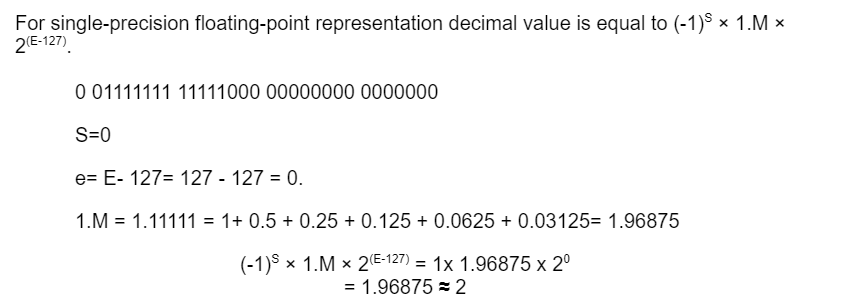
Consider the following 32-bit (single precision) IEEE-754 format:

S

E

M

0

0111 1111

1111 1000 0000 0000 0000 000

The decimal value closest to this floating-point number is____

2
3
1
4
Difficulty Level: 1
Positive Marks: 1.00
Negative Marks: 0.33
Consider a gray code word gn...g2g1g0 and the corresponding binary number bn...b2b1b0. Which of the following represents the equation for ith digit bi?
bi= gn ⊕gn-1⊕ gn-2 ⊕ ...⊕ gi.
bi= g1 ⊕g2 ⊕ g3 ⊕ ...⊕ gi-1.
bi= gn ⊕gn-1⊕ gn-2 ⊕ ...⊕ gi-1.
bi= g1 ⊕g2 ⊕ g3 ⊕ ...⊕ gi.
Difficulty Level: 1
Positive Marks: 2.00
Negative Marks: 0.66
Let f(w,x,y,z)= w’+x+y’+wx’yz. Simplified expression of f(w,x,y,z) is____
w’ + x + y’ + z
w’ + x + y + z
w + x’ + y + z’
w + x + y + z
Difficulty Level: 1
Positive Marks: 2.00
Negative Marks: 0.66
How many parity bits must be appended to a 7-bit ASCII code to make it an error correcting Hamming Code?
4
3
2
1
Difficulty Level: 1
Positive Marks: 2.00
Negative Marks: 0.66
Which of the following is the sum of minterms form for the function function f(A⊕B⊕C⊕D)?
Σ(1,2,4,7,8,11,13,14)
Σ(0,3,5,6,9,10,12,15)
Σ(1,2,4,7,8,11,13,15)
Σ(0,3,5,6,9,10,12,14)
Difficulty Level: 1
Positive Marks: 2.00
Negative Marks: 0.66