Let ‘A’ be any square matrix and |A| be determinant, then which of the following is incorrect?
The value of the determinant does not change when all rows and columns are interchanged.
If any two rows (or two columns) of a determinant are interchanged, the value of determinant does not change.
If all elements of a row (or column) of a determinant are multiplied by the same number k, the value of the new determinant is k times the given determinant.
If A be an n-rowed square matrix, and ‘k’ be any scalar then |kA|=k^n|A|.
Correct Answer
Option 2
Solution
If any two rows (or two columns) of a determinant are interchanged the determinant is multiplied by ‘-1’.
Remaining are standard theorems on determinant make a note of it.
Difficulty Level: 1
Positive Marks: 2.00
Negative Marks: 0.66
If the determinant value
then the value of ‘x’ is
abc
2abc
3abc
1
Correct Answer
Option 2
Solution
Difficulty Level: 1
Positive Marks: 2.00
Negative Marks: 0.66
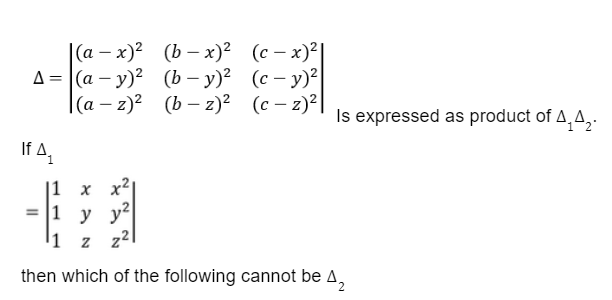
The determinant
Correct Answer
Option 1
Solution
We can take (-2) out.
Given that
We can take (-2) inside the determinant i.e., we can multiply (-2) with any one row or one column.
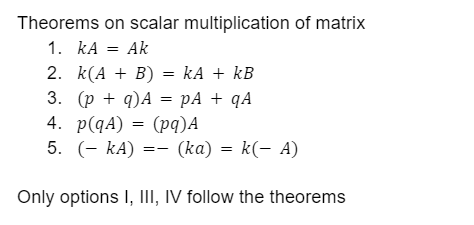
Only the option
cannot be delta 2.
Difficulty Level: 1
Positive Marks: 2.00
Negative Marks: 0.66
Which of the following matrices are equivalent?
Correct Answer
Option 3
Solution
Equivalence of matrices: Two matrices said to be equivalent, if they are derived from same normal form using any operation i.e.,
if they are from the same matrix, they are equivalent.
Conditions:
must be same size
same rank
are not the same in size.
are also not the same size.
rank is 2 and rank is 3.
So, all the above are not equivalent.
and have the same size and rank.
So they are equivalent.
Difficulty Level: 1
Positive Marks: 2.00
Negative Marks: 0.66
The number of solutions for the following homogeneous equations.
x+y+z=0
2x-y-3z=0
3x-5y+4z=0
x+17y+4z=0
infinite
Unique, Zero solution
unique, non-zero
more than one, non-zero
Correct Answer
Option 2
Solution
Difficulty Level: 1
Positive Marks: 2.00
Negative Marks: 0.66
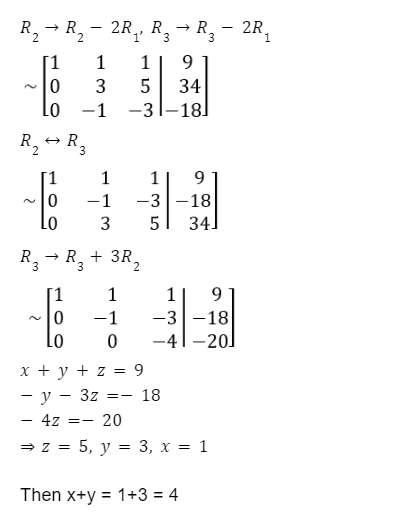
The following linear non-homogeneous system has a unique solution x, y, z.
x+y+z= 9
2x+5y+7z=52
2x+y-z=0
The value of x + y in the solution is ______
4
Correct Answer
Option 1
Solution
Difficulty Level: 1
Positive Marks: 2.00
Negative Marks: 0.00
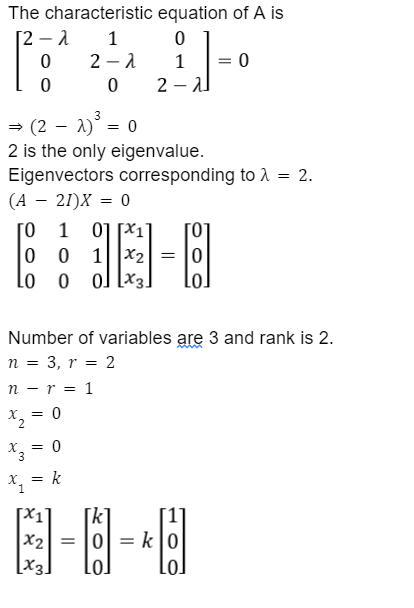
Which of the following is eigen vector of the matrix
Correct Answer
Option 1
Solution
Difficulty Level: 1
Positive Marks: 2.00
Negative Marks: 0.66
The lower triangular matrix ‘L’ in the LU-decomposition of the matrix
is _______.
Correct Answer
Option 2
Solution
Difficulty Level: 1
Positive Marks: 2.00
Negative Marks: 0.66
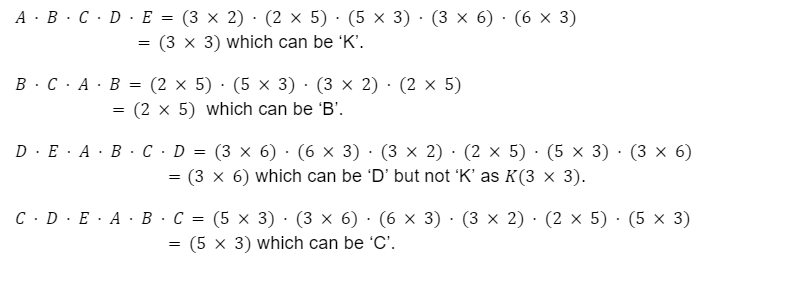
Let there are six matrices with size as A(3×2), B(2×5), C(5×3), D(3×6), E(6×3), K(3×3). Then which of the equations with multiplication of matrices is incorrect?
A.B.C.D.E=K
B.C.A.B=B
D.E.A.B.C.D=K
C.D.E.A.B.C=C
Correct Answer
Option 3
Solution
Difficulty Level: 1
Positive Marks: 2.00
Negative Marks: 0.66
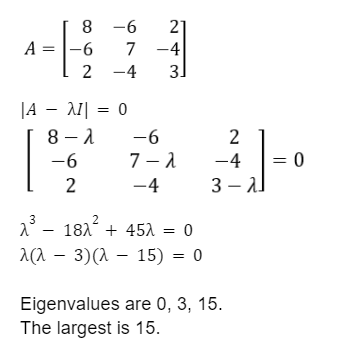
The largest eigenvalue of the matrix
is ______
15
Correct Answer
Option 1
Solution
Difficulty Level: 1
Positive Marks: 1.00
Negative Marks: 0.00
The sum of eigenvalues of the matrix
is _____
24
Correct Answer
Option 1
Solution
The sum of the eigenvalues of the matrix = Trace
Given matrix,
Trace = 8 + 4 + 9 + 3 = 24
Sum of eigenvalues = 24
Note: Product of eigenvalues = determinant.
Difficulty Level: 1
Positive Marks: 1.00
Negative Marks: 0.00
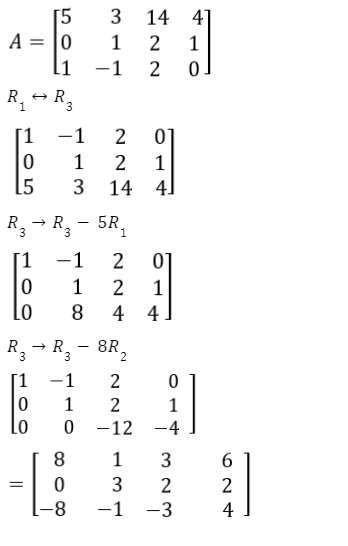
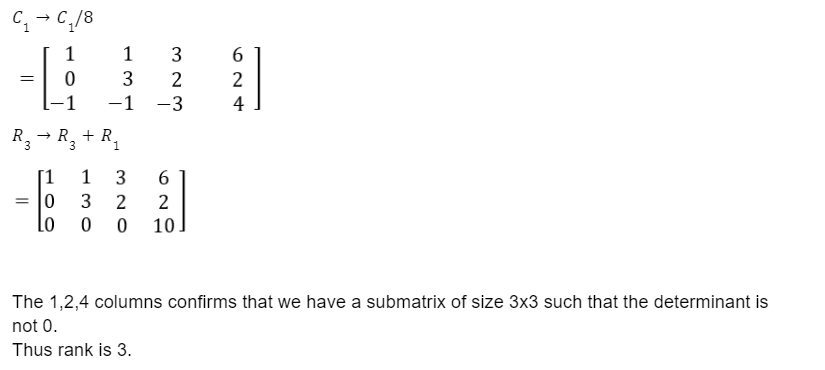
Rank of the matrix
is __
3
Correct Answer
Option 1
Solution
Difficulty Level: 1
Positive Marks: 1.00
Negative Marks: 0.00
-88/419
88/417
88/419
--88/417
Correct Answer
Option 3
Solution
Difficulty Level: 1
Positive Marks: 1.00
Negative Marks: 0.33
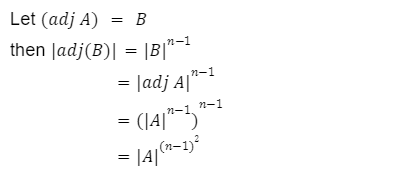
If ‘A’ is a square matrix of order ‘n’, then |adj (adj A)| is ______.





 are not the same in size.
 are also not the same size.
 rank is 2 and
  rank is 3.
 and
and  have the same size and rank.