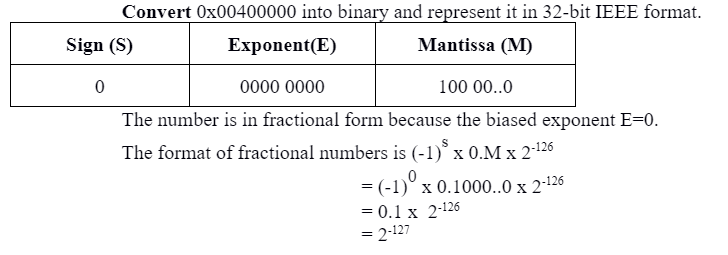
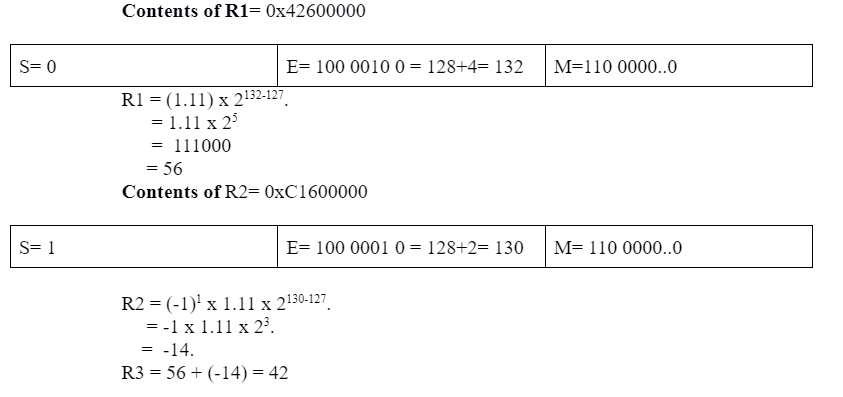
Consider the registers R1 that store a number in IEEE-754 single precision floating point format. Let R1 contain the value (in hexadecimal notation) 0x00400000. What is the decimal value of the number which is stored in R1?
C= {1000, 0100, 0010, 0001}.
Which of the following statements is true?
M1= 10101001
M2= 01110000
Which one of the above multipliers requires relatively less number of ADD/SUB operations?
What is the state of the register after 4 Clocks?
Output Y = 1 when inputs a2a1a0 and b2b1b0are equal. Initially all the counters are cleared. So, initially Y=1. Eleven external clock pulses are needed to get output Y = 1 again. What is the state of counter 2 or counter 3 after eleven clock pulses?
Then the expression for Q0n=

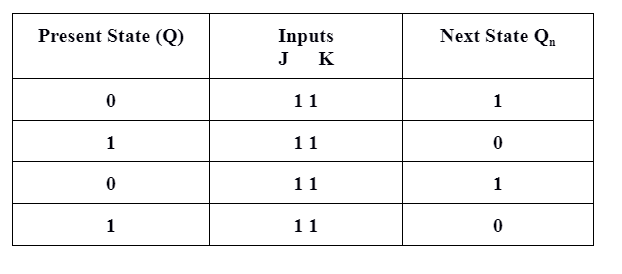
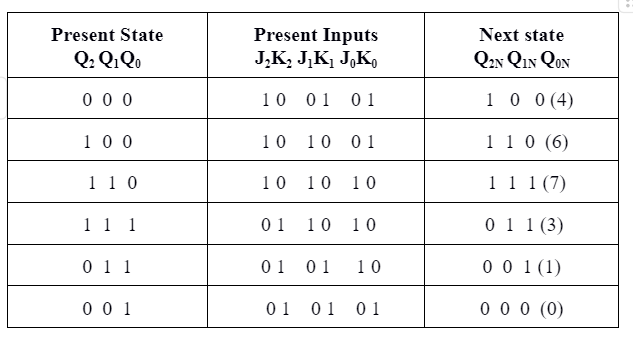
Which of the following are the next 4 states of the state sequence of the JK flip-flop?
Which of the following is the state sequence of the counter?