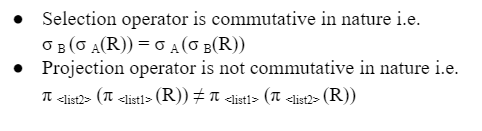
Which of the following is not a relational algebra operation?
Select
Rename
Insert
Union
Difficulty Level: 1
Positive Marks: 1.00
Negative Marks: 0.33
In the tuple relational calculus ¬(¬(P1)∨¬(P2)) is equivalent to
P1∧P2
P1∨P2
P1→P2
P1↔P2
Difficulty Level: 1
Positive Marks: 1.00
Negative Marks: 0.33
The join operation can be expressed as:
R ⟗ S
STUDENT ⋈Student.Std = Subject.Class SUBJECT
R ⟖ S
All of the above
Difficulty Level: 1
Positive Marks: 1.00
Negative Marks: 0.33
Let R be a relation of degree d. How many different projections are possible on R?
2^d-1
d
d+1
d^2+1
Difficulty Level: 1
Positive Marks: 1.00
Negative Marks: 0.33
Which of the following is the complete set of relational algebra operations (i.e., Any of the other relational algebra operations can be expressed as a sequence of operations from this set)
{ σ, π, ∪, ⨝ }
{ σ, π, ∪, – }
{ σ, π, ∩, – }
{ σ, π, ∪, ρ, -, × }
Difficulty Level: 1
Positive Marks: 1.00
Negative Marks: 0.33
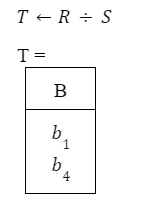
Consider the following two relations:

If TRS then the number of rows T contains is ______

2
Difficulty Level: 1
Positive Marks: 2.00
Negative Marks: 0.00
Consider the following statements S1 and S2:

S1: The set of relational algebra operations {σ, π, ∪, ρ, –, ×} is a complete set.

S2: Any of the other original relational algebra operations can be expressed as a sequence of operations from the set in S1.

Which of the following is Correct?
both S1 and S2 are correct
both S1 and S2 are incorrect
S1 is correct but S2 is incorrect
S1 is incorrect but S2 is correct
Difficulty Level: 1
Positive Marks: 2.00
Negative Marks: 0.66
Which of the following is Incorrect?
R∪S=S∪R and R∩S=S∩R
R∪(S∪T) = (R∪S)∪T
(R∩S)∩T = R∩(S∩T)
R-S = S-R
Difficulty Level: 1
Positive Marks: 2.00
Negative Marks: 0.66
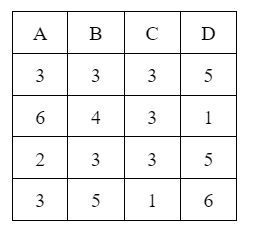
Consider the following relations R and S. Compute R⋈S and identify which of the following records will be there in the result?

2, 3, 3, 5
3, 3, 1, 6
6, 4, 4, 1
3, 5, 3, 1
Difficulty Level: 1
Positive Marks: 2.00
Negative Marks: 0.66
Which of the following TRC expression will find the firstname and lastname of employees whose salary is more than 20000?
{t.FNAME, t.LNAME | EMPLOYEE(t) AND t.SALARY>20000}
{t | EMPLOYEE(t) AND t.SALARY>20000}
{t.FNAME, t.LNAME | EMPLOYEE(t) OR t.SALARY>20000}
{t.FNAME, t.LNAME | EMPLOYEE(t) AND t.SALARY≥20000}
Difficulty Level: 1
Positive Marks: 2.00
Negative Marks: 0.66
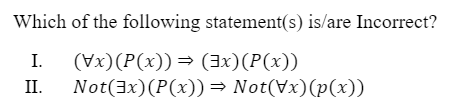
both I and II
only I
only II
Neither I nor II
Difficulty Level: 1
Positive Marks: 2.00
Negative Marks: 0.66
Which of the following statements is/are CORRECT?

S1: In relational algebra selection (σ) operator is commutative.

S2: In relational algebra projection (π) operator is commutative.
Both S1 and S2 are correct
Both S1 and S2 are incorrect
S1 is correct but S2 is incorrect
S1 is incorrect but S2 is correct
Difficulty Level: 1
Positive Marks: 2.00
Negative Marks: 0.66
Which of the following operations can be expressed as a sequence of π, X and –(minus)?

UNION (⋃)
INTERSECTION (⋂)
SELECTION (σ)
DIVISION (÷)
Difficulty Level: 1
Positive Marks: 2.00
Negative Marks: 0.66
Consider the join of a relation R with a relation S. If R has ‘x’ tuples and S has ‘y’ tuples then maximum and minimum size of the join respectively are:
x+y and 0
x+y and x-y
xy and 0
xy and x+y
Difficulty Level: 1
Positive Marks: 2.00
Negative Marks: 0.66
Let Employee(Eid, Ename, Se, Dno) and Department(Dno, Dname) are two relational schemas with primary keys as underlined. The relation employee contains 800 tuples and the relation department contains 500 tuples. What is the maximum number of tuples in (Employee ⨝ Department)?
800000
500
800
0
Difficulty Level: 1
Positive Marks: 2.00
Negative Marks: 0.66