Which of the following is true about 2-phase locking protocol?

S1: Lock upgradation and degradation are allowed only in the shrinking phase.

S2: 2-phase locking allows lock degradation in shrinking phase.

Only S1
Only S2
Both S1 and S2
Neither S1 nor S2
Difficulty Level: 1
Positive Marks: 1.00
Negative Marks: 0.33
Consider the schema Person(id, name, age, hobby) and identify the CORRECT relational algebra expression to select the persons whose age is above 20 and below 30?
σ age>20 AND age<30 (Person)
σ age>20 OR age<30 (Person)
σ age<20 AND age>30 (Person)
σ 20< age<30 (Person)
Difficulty Level: 1
Positive Marks: 1.00
Negative Marks: 0.33
If a table has an index table like the following:

Which of the following is CORRECT for the above indexing?

Primary index
Secondary index
Clustering index
Non-clustering index
Difficulty Level: 1
Positive Marks: 1.00
Negative Marks: 0.33
Consider the relational schema emp(emp_id, emp_name, sal, dept_id); with primary key as underlined. What does the following SQL query returns?

SELECT emp_name from emp GROUP BY dept_id;

All employee names are displayed
It will throw an error
All employee names department wise are displayed
None of these
Difficulty Level: 1
Positive Marks: 1.00
Negative Marks: 0.33
Which of the following statements is/are true about selection and projection operation? [MSQ]

Selection operator is used to filter rows.
Projection operator is used to filter columns.
Projection operator does not eliminate duplicates automatically from output.
None
Difficulty Level: 1
Positive Marks: 1.00
Negative Marks: 0.00
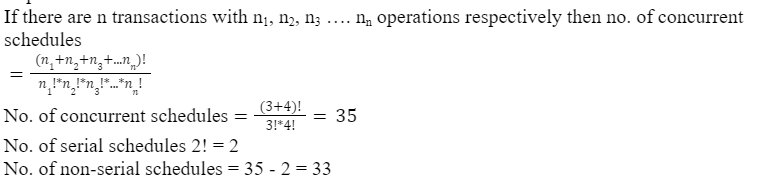
Find the no. of non-serial schedules possible over 2 transactions with 4 and 3 operations.
33
Difficulty Level: 1
Positive Marks: 1.00
Negative Marks: 0.00
Which of the following operator can be used between main query and subquery?

EXIST
BETWEEN
LIKE
IS NULL
Difficulty Level: 1
Positive Marks: 1.00
Negative Marks: 0.33
Which one of the following is not CORRECT?
Relation is in 1NF but not in 2NF
Relation is in 3NF but not in BCNF
Relation is in 2NF but not in 3NF
Relation is in 3NF but not in 2NF
Difficulty Level: 1
Positive Marks: 1.00
Negative Marks: 0.33
The attribute AGE is calculated from DATE_OF_BIRTH. The attribute AGE is
Single valued
Multi valued
Composite
Derived
Difficulty Level: 1
Positive Marks: 1.00
Negative Marks: 0.33
Consider the following ER diagram:

Minimization of ER Diagrams - GeeksforGeeks

The minimum number of tables needed to convert the given ER diagram into the relational model?

1
2
3
4
Difficulty Level: 1
Positive Marks: 1.00
Negative Marks: 0.33
Consider the following ER diagram:

ER Diagrams to Tables | Gate Vidyalay

Which of the following attribute set is correct representation when the above ER diagram is converted into a minimum number of relations in a relational model?

(b1,b2)
(a1, a2, b1)
(b1, b2, a1)
(a1, a2, b1, b2)
Difficulty Level: 1
Positive Marks: 1.00
Negative Marks: 0.33
Identify the correct statement(s)?
Student(rno#, sname, marks) is a relation instance.
(15, RBR, 98) is an instance of a relation schema
(15, RBR, 98) specifies a relation schema
(15, RBR, 98) is neither an instance of a relation schema nor specifies a relation schema
Difficulty Level: 1
Positive Marks: 1.00
Negative Marks: 0.33
Which of the following statements is/are true?

S1: In relationship algebra σ (selection) operation is NOT commutative.

S2: In relational algebra ⊓(projection) operation is commutative.

Only S1
Only S2
Both S1 and S2
Neither S1 nor S2
Difficulty Level: 1
Positive Marks: 1.00
Negative Marks: 0.33
Blind write always appears in
Conflict serializable schedule
View serializable schedule
Both of the above
None of the above
Difficulty Level: 1
Positive Marks: 1.00
Negative Marks: 0.33
Consider a relation R with A1, A2, A3,…..., An attributes. How many numbers of super keys are possible for R, if every attribute is the candidate key?
2^n
2^(n-1)
2^(2n-1)
2^n-1
Difficulty Level: 1
Positive Marks: 1.00
Negative Marks: 0.33
The problem that occurs when one transaction updates a database item and then the transaction fails for some reason is ________.

Temporary Select Problem
Temporary Modify Problem
Dirty Read Problem
None
Difficulty Level: 1
Positive Marks: 1.00
Negative Marks: 0.33
Match the following:

1-c, 2-d, 3-b, 4-a
1-c, 2-b, 3-d, 4-a
1-b, 2-a, 3-c, 4-d
1-c, 2-d, 3-a, 4-b
Difficulty Level: 1
Positive Marks: 2.00
Negative Marks: 0.66
How can we avoid cascading rollbacks?

  1. Using strict two-phase locking protocol
  2. Using rigorous two-phase protocol
  3. Using basic two-phase locking protocol
I only
I and II only
II and III only
I, II and III
Difficulty Level: 1
Positive Marks: 2.00
Negative Marks: 0.66
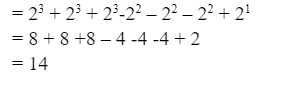
Let there be relation R(A, B, C, D, E) with FD set: {A → BC, C → D, D → A}. How many super keys are possible?
10
11
13
14
Difficulty Level: 1
Positive Marks: 2.00
Negative Marks: 0.66
Consider a relation R (ABCDE) with the following dependencies

A ⟶ B

C ⟶ D

AC ⟶ E

D ⟶ C

What is the highest normal form that R satisfies?

1NF
2NF
3NF
BCNF
Difficulty Level: 1
Positive Marks: 2.00
Negative Marks: 0.66
Let transactions T1, T2 and T3 be defined to perform the following operations:

T1: Add 5 to A

T2: Double A

T3: Display A on the screen and then set it to 1 i.e., A = 1.

(Where A is same item in the database)

Suppose transactions T1, T2 and T3 are allowed to execute concurrently. If A has initial value zero, report the possible values of final value of A and the displayed value of A

I – 1, 10

II – 2, 5

III – 7, 0

IV – 12, 0

I and III only
I, II, III only
II and IV only
I, II, III and IV
Difficulty Level: 1
Positive Marks: 2.00
Negative Marks: 0.66
Consider the given table Result:

Identify the CORRECT query to find out the students who have scored more than 70 marks and displaying them in ascending order according to their marks?

[MSQ]

SELECT student_name, marks

FROM Result

WHERE marks>70

ORDER BY marks ASC;

SELECT *

FROM Result

WHERE marks>70

ORDER BY marks ASC;

SELECT student_name, marks

FROM Result

WHERE marks>70

ORDER BY marks;

None
Difficulty Level: 1
Positive Marks: 2.00
Negative Marks: 0.00
Consider the given table Result:

Identify the query for student who stood second?

select student_name from Result order by marks desc offset 1 rows fetch next 1 rows only;
select student_name from Result order by marks desc fetch next 2 rows only;
select student_name from Result order by marks desc offset 1 rows fetch next 2 rows only;
select student_name from Result order by marks desc offset 2 rows;
Difficulty Level: 1
Positive Marks: 2.00
Negative Marks: 0.66
Consider the given functional dependencies:

A->B

BC->DE

AEF->G

Which of the following is TRUE?

Functional dependency AF->DG implied by the set
Functional dependency ACF->DG cannot be implied by the set
Functional dependency AB->G implied by the set
None of the options are correct
Difficulty Level: 1
Positive Marks: 2.00
Negative Marks: 0.66
Consider a schema R(A,B,C,D) and functional dependencies A->B and C->D.

S1: The relation R is in 1NF but not in 2NF.

S2: The decomposition of R into R1(AB) and R2(CD) is dependency preserving and lossless join.

Which of the statements is/are CORRECT about R?

Both S1 and S2
Only S1
Only S2
Neither S1 nor S2
Difficulty Level: 1
Positive Marks: 2.00
Negative Marks: 0.66
Consider the relation R(ABCDE) and its functional dependencies:

AB->C

C->E

B->D

E->A

The relation R is decomposed into R1(BCD) and R2(ACE). Which of the following option is correct about the decomposition?

Decomposition is lossy and dependency preserving
Decomposition is lossless and dependency preserving
Decomposition is lossy and not dependency preserving
Decomposition is lossless and not dependency preserving
Difficulty Level: 1
Positive Marks: 2.00
Negative Marks: 0.66
Consider the following relational instance:

Which of the following functional dependencies are satisfied by the instance?

AB->C and C->B
BC->A and B->C
BC->A and A->C
AC->B and B->A
Difficulty Level: 1
Positive Marks: 2.00
Negative Marks: 0.66
Consider an empty relation R(AB) where A is primary key and B is foreign key referring same relation R. Which one of the following row sequence can be inserted into R?
(1, 2) (2, 3) (3, 4) (4, 5)
(1, NULL) (2, 1) (3, 2) (4, 3)
(1, NULL) (2, NULL) (4, 3) (5, 4)
None of the above
Difficulty Level: 1
Positive Marks: 2.00
Negative Marks: 0.66
Consider the following schedules.

S1) R1(B) R1(A) R1(B) W1(B) W1(A) R1(A) W1(B)

S2) R1(B) R1(A) W1(A) R2(B) W2(B) R1(B) W1(B)

S3) R1(B) R1(A) W1(A) R2(B) W2(B) W1(B)

Which of the above schedules results in both unrepeatable reads and dirty read?

S1 and S2
Only S2
Only S3
S2 and S3
Difficulty Level: 1
Positive Marks: 2.00
Negative Marks: 0.66

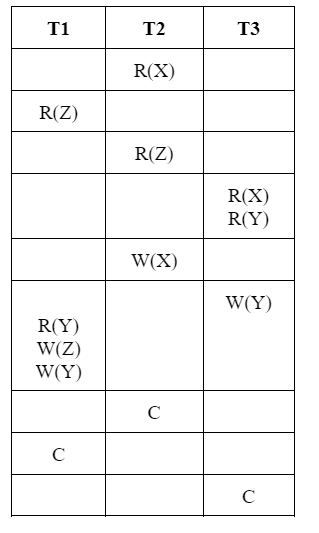
Cascadeless schedule
Strict schedule
Recoverable schedule
Non-recoverable schedule
Difficulty Level: 1
Positive Marks: 2.00
Negative Marks: 0.66
Calculate the no. of index records that can be stored in a B tree of 4 levels of order 24. (Assume that each node is 69% full)
65535
Difficulty Level: 1
Positive Marks: 2.00
Negative Marks: 0.00
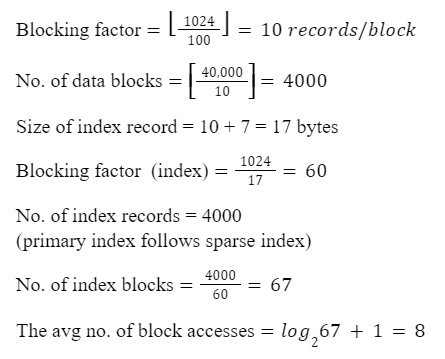
Suppose we have an ordered file with 40000 records stored on disk with block size 1024 bytes. For storing the records into a block we follow unspanned strategy with record size R=100 bytes. Suppose we created a primary index with a key field of a file 10 bytes size and block pointer is 7 bytes. Then the average number of access to search a record with index is _____.

8
Difficulty Level: 1
Positive Marks: 2.00
Negative Marks: 0.00
Consider the following B tree with order 3

After deletion of 50, 40, 30 what is the resultant B tree?

Difficulty Level: 1
Positive Marks: 2.00
Negative Marks: 0.66