How many unique numbers of MSTs can possible using Prim’s and Kruskal's algorithms. [ Hint: Not required to use kirchhoff's theorem ]

1
Difficulty Level: 1
Positive Marks: 1.00
Negative Marks: 0.00
What is the time complexity of Dijkstra’s algorithm if it is implemented using Binary Min-heap over a graph G=(V,E)?
O(ElogV)
O(VlogV+E)
O(ElogE)
None of the above
Difficulty Level: 1
Positive Marks: 1.00
Negative Marks: 0.33
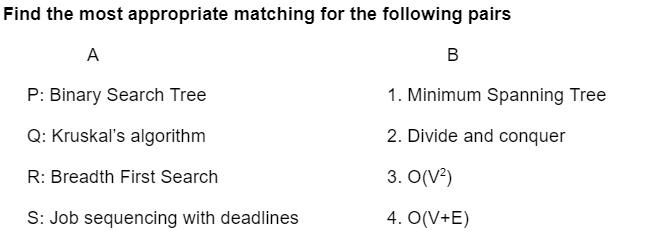
P-2, Q-1, R-4 and S-3
P-4, Q-2, R-3 and S-1
P-2, Q-1, R-3 and S-4
P-4, Q-2, R-1 and S-3
Difficulty Level: 1
Positive Marks: 1.00
Negative Marks: 0.33
What is the worst case time complexity for topological sorting.
O(V^2)
O(V+E)
O(ElogV)
O(VlogV+E)
Difficulty Level: 1
Positive Marks: 1.00
Negative Marks: 0.33
Find the total number of strongly connected components for a given graph is ____?

4
Difficulty Level: 1
Positive Marks: 1.00
Negative Marks: 0.00
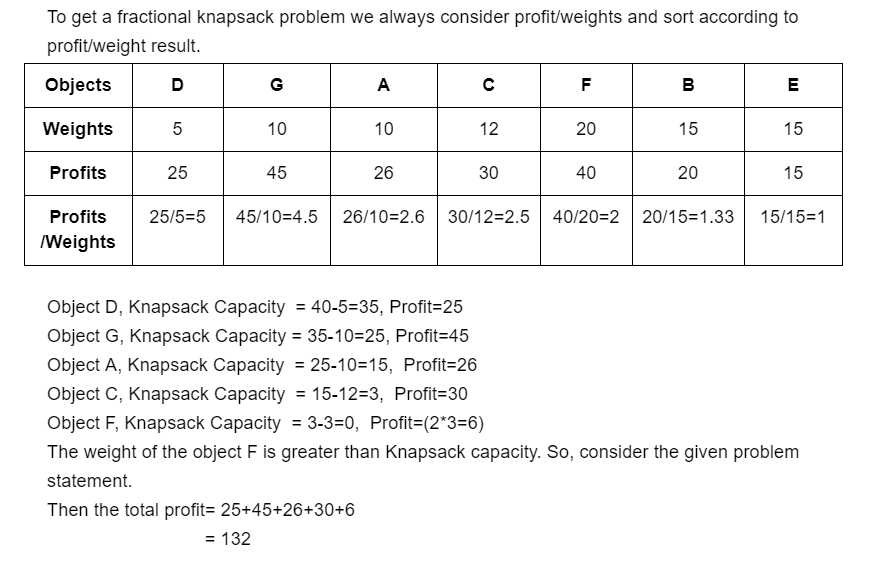
The Knapsack bag maximum Capacity is 40. Find out the maximum profit using greedy Knapsack or Fractional Knapsack___?

[Note: Consider only 2 decimal points if it necessary]
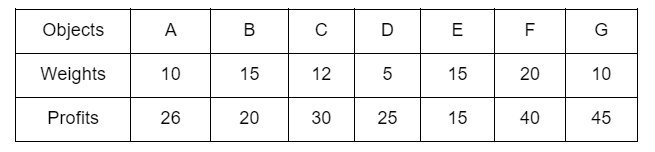
132
Difficulty Level: 1
Positive Marks: 2.00
Negative Marks: 0.00
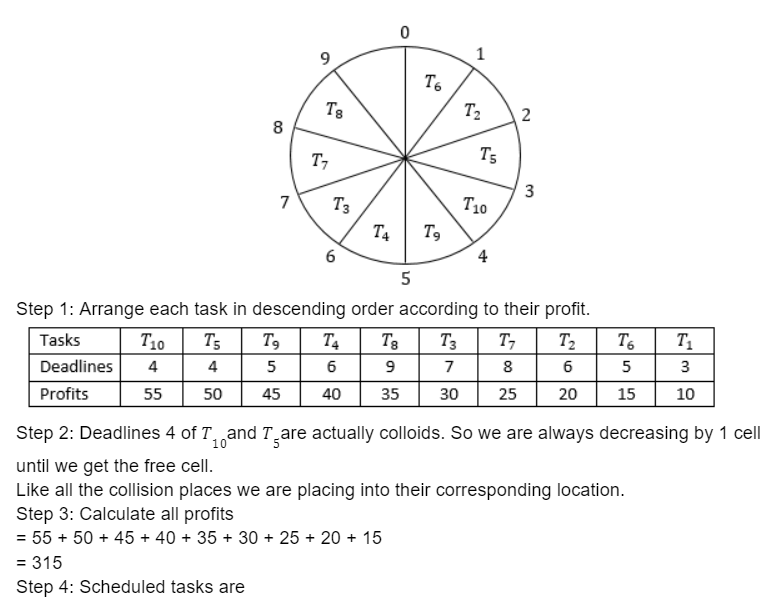
315
Difficulty Level: 1
Positive Marks: 2.00
Negative Marks: 0.00

Suppose we have a Single Source Shortest Path on the following Adjacency Matrix with vertex 0 as the source.

Find out the total cost for reaching all other vertices from the source node for which the shortest path distances are finalized____ ?

34
Difficulty Level: 1
Positive Marks: 2.00
Negative Marks: 0.00
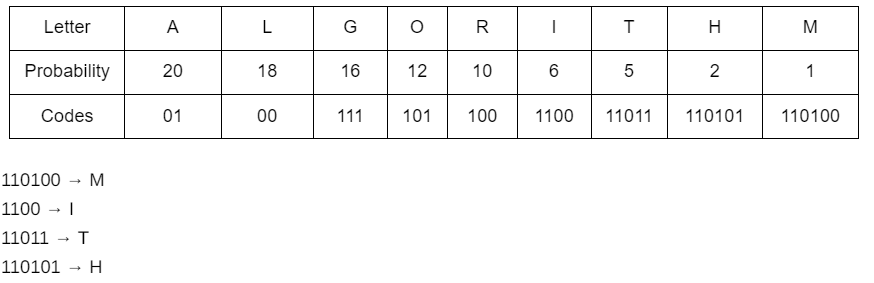
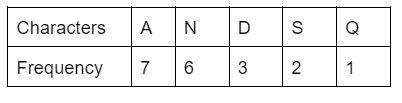
Bob has wanted to send a message to Alice. Bob uses the encrypted message by using given letters along with probabilities of their occurrence.

Alice got a message in combination of 1’s and 0’s. Alice needs to apply a huffman code algorithm to understand the given message.

110100110011011110101

Find the decrypted message sent by Bob is____? [ Hint: consider left node as 0 ]

ALGO
MITH
ALTH
THGO
Difficulty Level: 1
Positive Marks: 2.00
Negative Marks: 0.66
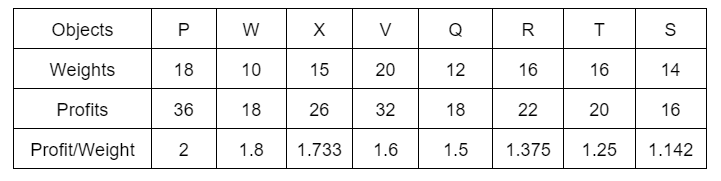
The following Knapsack bag maximum Capacity is 50 and the maximum profit is 91.2. Find all the objects which are not part of maximum profit?

Q,R,T and S
T and S
X, V and Q
None of the above
Difficulty Level: 1
Positive Marks: 2.00
Negative Marks: 0.66
The graph shown below 9 edges with distinct integer edge weights. The minimum spanning tree (MST) is of weight 42 and contains the edges: {(A, B), (B, D), (C, D), (B, E), (E, G), (F,G)}. The edge weights of only those edges which are in the MST are given in the figure shown below. The minimum possible sum of weights of all 9 edges of this graph is _____?

72
Difficulty Level: 1
Positive Marks: 2.00
Negative Marks: 0.00
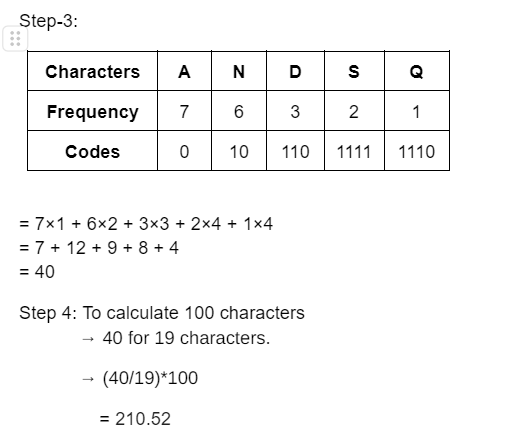
The message contains the different characters.

AAANNNAAAANNNDDDSSQ

A message of 100 characters over X is encoded using Huffman coding. Then the expected length of the encoded message in bits is____? [Note: Consider only 2 decimal points if it necessary]
210.52
Difficulty Level: 1
Positive Marks: 2.00
Negative Marks: 0.00
There are 6 elements named as A,B,C,D,E,F are sorted sequences having lengths 25,29,35,40,55,60 respectively. They are to be merged into a single sequence by merging together two sequences at a time. The number of comparisons that will be needed in the worst case by the optimal algorithm for doing this is ___?
612
Difficulty Level: 1
Positive Marks: 2.00
Negative Marks: 0.00
Which of the following statement(s) is/are TRUE?

I. It is often faster to add and remove edges from G when using an adjacency matrix.

II. Suppose that Dijkstra’s algorithm is run using a priority queue data structure for which insert and decrease key operations take O(log log V) time, extra-min operation take O(√V) time then the running time of Dijkstra’s algorithm on a directed weighted graph G = (V, E) containing non-negative edges will be O(V√V) + E log log V)

Only I
Only II
Both I and II
Neither I nor II
Difficulty Level: 1
Positive Marks: 2.00
Negative Marks: 0.66
Which of the following statement(s) is/are True?

P: The sum of distinct weights of the minimum spanning trees obtained by Prim's and Kruskal's algorithm are always equal.

Q: In Huffman Coding, the item with the highest probability is always at the leaf that is closest to the root

R: Given a graph G = (V,E) with positive edge weights, the Bellman-Ford algorithm and Dijkstra’s algorithm can produce different shortest-path trees despite always producing the same shortest-path weights.

P and Q
Q and R
Only Q
All the above
Difficulty Level: 1
Positive Marks: 2.00
Negative Marks: 0.66